빠른 제작과 다양한 마감 옵션을 제공하는 박물관 수준의 지클레이 및 캔버스 프린트. ( 수작업 채색 복제본 주문하기 디지털 이미지로 전환)





























작품의 원본 비율을 그대로 유지하는 프리셋 사이즈 중에서 선택해 보세요.

액자나 벽면 크기에 맞춰 필요한 가로와 세로 길이를 입력해 주세요. 프린트는 원본 이미지보다 크게 제작할 수 없으며 오직 자르는 것만 가능하므로, 비율이 다른 사이즈를 선택할 경우 이미지의 일부가 잘려 나갈 수 있습니다. 인쇄 작업에 들어가기 전, 최종 확인을 위해 디지털 목업을 보내드립니다. 이 페이지에 표시된 이미지는 실제 잘리는 영역을 나타내지 않으며, 오직 목업을 통해서만 정확한 확인이 가능합니다.
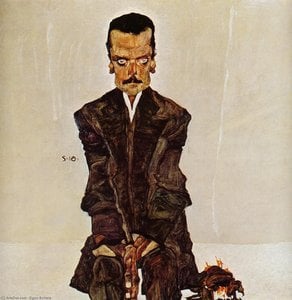
untitled (2624)
복제본 크기
In the hauntingly beautiful realm of Austrian Expressionism, few works command the viewer's attention with such visceral intensity as Egon Schiele’s Untitled (2624). This arresting portrait captures a moment suspended in time, where palpable intimacy meets an underlying sense of profound unease. The composition presents a striking duality: a man seated upon the floor, anchored by gravity and perhaps a heavy psychological weight, while a woman stands above him, her presence both commanding and tender. It is a scene that transcends mere depiction, inviting us into a private theater of vulnerability, desire, and the fraught, often turbulent dynamics inherent in human connection.
The eye is immediately ensnared by the painting's dramatic color palette. A dominant, vibrant crimson saturates the background, acting as a powerful visual pulse that beats behind the figures. This choice of hue is far from accidental; historically, such deep reds evoke a complex spectrum of human experience, ranging from the heat of passion to the starkness of violence and impending doom. Against this fiery backdrop, the muted tones of the figures emerge with a startling clarity, creating a dramatic counterpoint that heightens the emotional stakes of their silent confrontation.
Schiele’s mastery lies in his ability to use the very anatomy of his brushwork to communicate the unutterable. His signature technique—characterized by expressive, agitated lines—rejects the polished smoothness of academic tradition in favor of a raw, nervous energy. These thick, often jagged strokes do not merely outline the human form; they seem to vibrate with the internal tremors of the subjects' souls. Through distorted perspectives and exaggerated contours, Schiele bypasses the surface of the skin to explore the musculature of emotion itself.
For the discerning collector or interior designer, this piece offers a profound sense of movement and psychological texture. The artist’s meticulous attention to the rendering of skin textures and the tension in the limbs serves as a vehicle for emotional expression, making the artwork feel alive within a space. Whether placed in a contemporary gallery setting or a sophisticated private study, the painting acts as a window into the inner psyche, offering a depth that invites long periods of contemplation and discovery.
To truly appreciate the gravity of this work, one must consider the turbulent historical landscape from which it emerged. Painted circa 1915, the piece was birthed during the height of World War I, a period that cast a long, somber shadow over Europe. Schiele’s personal life was equally marked by upheaval; his recent marriage to Edith Harms and his subsequent draft into military service infused his work with an inescapable preoccupation with mortality and the fragility of existence. The tension between the two figures in Untitled (2624) can be seen as a microcosm of this larger, global anxiety—a struggle for connection amidst a world on the brink of collapse.
This masterpiece is more than a historical artifact; it is an enduring exploration of the human condition. It speaks to the universal experience of longing and the fear of loss, making it a timeless addition to any collection. For those seeking to infuse their environment with art that possesses both intellectual rigor and emotional resonance, Schiele’s work stands as a monumental testament to the power of the human spirit to find beauty within the most turbulent of shadows.
"untitled (2624)"의 작가인 에곤 실레는 에곤 레오 오돌프 루이스 실레 등의 다른 이름으로도 알려져 있습니다.
"untitled (2624)"은(는) 디지털 이미지 파일 페이지에서 고해상도 디지털 이미지 다운로드 형태로 직접 구매하실 수 있습니다.
에곤 실레의 "untitled (2624)"의 저작권 정보: 해당 작품은 퍼블릭 도메인 - 저작권 보호 기간이 만료되었습니다 상태입니다. 이는 이미지 복제 가능 여부를 결정하는 기준이 됩니다.


1890 - 1918 , 오스트리아 크로아티아
뭉크, 키르히너 등 거장들의 작품으로 표현주의 미술의 정수를 만나보세요. 강렬한 색채와 감정적 깊이가 깃든 명작 10선을 통해 예술의 세계를 탐험하고, WahooArt에서 고품질 아트 프린트를 소장하세요. 지금 바로 온라인 컬렉션을 확인하세요!

Explore the emotionally charged world of Egon Schiele (1890-1918). Discover his Expressionist masterpieces, psychological themes, and lasting impact on modern art. A comprehensive guide for collectors & enthusiasts.

에곤 시엘레 최고 걸작 25선을 만나보세요. 표현주의 화가 시엘레의 삶과 죽음, 불안을 담은 인물화 작품들을 감상하고 그 의미를 탐구합니다. WahooArt에서 명작 복제본으로 예술적인 공간을 완성하세요. 지금 바로 컬렉션을 확인하세요!

Explore 10 Expressionist paintings that revolutionized art! Discover Munch, Kirchner & Kandinsky's iconic works. Find museum-quality reproductions and vibrant canvas prints to elevate your home decor on WahooArt.com.

Explore 10 defining German Expressionism masterpieces – from Munch's 'The Scream' to Kandinsky’s abstracts. Discover the artists, stories & bold colors behind this powerful art movement. Find museum-quality reproductions at WahooArt.com.
 미리보기
미리보기
 공유하기
공유하기 공유하기
공유하기
 상세 정보
상세 정보 가이드 보기

 다운로드
다운로드
 유사 작품 더 보기
 X-레이
X-레이 슬라이드 쇼 보기
 질의응답
질의응답
 통계 정보
통계 정보

 더 보기
더 보기









 유리 옵션은 110cm 미만 크기에서만 선택 가능합니다.