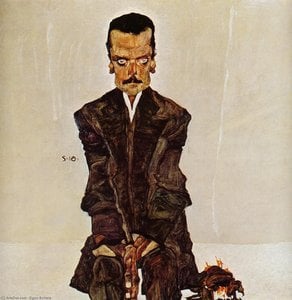
A Study in Vulnerability: Egon Schiele’s ‘untitled (2467)’
This captivating work by
Egon Schiele, created sometime between 1909 and 1918, is a quintessential example of early Expressionism. It presents a nude female figure draped with a striking red shawl, rendered with the raw emotional intensity that defines Schiele’s oeuvre. The painting isn't merely a depiction of the human form; it’s an exploration of psychological states – loneliness, introspection, and perhaps even a subtle sense of unease.
Decoding the Style & Technique
Schiele’s style is immediately recognizable for its angularity, distorted forms, and bold use of line. In ‘untitled (2467)’ we see these characteristics powerfully at play. The figure isn't idealized; rather, it’s presented with a deliberate lack of polish, emphasizing the vulnerability of the subject.
- Brushwork: Loose and gestural brushstrokes build up form and texture, creating a sense of immediacy and emotional rawness.
- Color Palette: The muted yellows and creams of the figure’s skin contrast dramatically with the vibrant red of the shawl. This color choice isn't accidental; it draws the eye and imbues the composition with tension.
- Composition: The flattened perspective, typical of Schiele’s work, rejects traditional notions of spatial depth, focusing instead on the emotional impact of the figure within the frame.
Historical Context & Artistic Influences
Schiele emerged during a period of profound social and artistic upheaval in Vienna. He was deeply influenced by Gustav Klimt – initially working under his tutelage – but quickly developed a distinct style that diverged from Klimt’s more decorative approach. Schiele, along with artists like Oskar Kokoschka, pushed the boundaries of representation, exploring themes previously considered taboo. His work often faced censorship and controversy due to its frank depiction of sexuality and psychological distress. He was part of a generation grappling with anxieties about modernity, identity, and mortality – all reflected in his art.
Symbolism & Emotional Resonance
The symbolism within ‘untitled (2467)’ is open to interpretation, but several elements stand out.
- The Red Shawl: The dominant red hue can be interpreted as representing passion, danger, or even a sense of confinement.
- The Reclining Figure: The pose suggests vulnerability and introspection. The figure’s gaze (though not directly visible) feels inward-focused, lost in thought.
- The Nude Form: Schiele frequently used the nude as a vehicle for exploring psychological states. It wasn't about simple eroticism but rather a stripping away of societal facades to reveal raw emotion.
A Lasting Legacy & Interior Design Considerations
Egon Schiele’s work continues to resonate with audiences today because of its unflinching honesty and emotional power. ‘untitled (2467)’ is a compelling piece for collectors seeking works that challenge conventional notions of beauty and representation. For interior designers, this painting can serve as a striking focal point in a modern or contemporary space. Its muted palette allows it to complement a variety of color schemes, while its expressive energy adds depth and intrigue to any room. The artwork’s melancholic tone lends itself well to spaces designed for contemplation and relaxation – bedrooms, studies, or libraries. A high-quality reproduction captures the essence of Schiele's technique, bringing a touch of Viennese Expressionism into your home or project.
질의응답
"untitled (2467)"의 색조는 얼마나 채도가 높나요?
에곤 실레의 "untitled (2467)"의 색상은 Clear Color Presence 정도의 채도를 띱니다. 채도는 색상이 얼마나 선명하거나 차분한지를 나타냅니다.
"untitled (2467)"은(는) 어떤 감정과 관련이 있나요?
에곤 실레의 "untitled (2467)"은(는) Melancholic 감성을 전달합니다.
학생들을 위한 에곤 실레의 "untitled (2467)" 관련 팩트시트가 있나요?
에곤 실레의 "untitled (2467)"의 가이드 페이지에서는 인쇄 가능한 두 장 분량의 학습용 팩트시트를 제공합니다. 여기에는 작품과 작품 정보표, 작가의 생애 속 시기를 보여주는 연대기, 해당 작가의 다른 작품들, 측정된 컬러 팔레트, 그리고 네 가지 스타일로 바로 복사하여 사용할 수 있는 인용 문구가 포함되어 있습니다.