빠른 제작과 다양한 마감 옵션을 제공하는 박물관 수준의 지클레이 및 캔버스 프린트. ( 수작업 채색 복제본 주문하기 디지털 이미지로 전환)





























작품의 원본 비율을 그대로 유지하는 프리셋 사이즈 중에서 선택해 보세요.

액자나 벽면 크기에 맞춰 필요한 가로와 세로 길이를 입력해 주세요. 프린트는 원본 이미지보다 크게 제작할 수 없으며 오직 자르는 것만 가능하므로, 비율이 다른 사이즈를 선택할 경우 이미지의 일부가 잘려 나갈 수 있습니다. 인쇄 작업에 들어가기 전, 최종 확인을 위해 디지털 목업을 보내드립니다. 이 페이지에 표시된 이미지는 실제 잘리는 영역을 나타내지 않으며, 오직 목업을 통해서만 정확한 확인이 가능합니다.
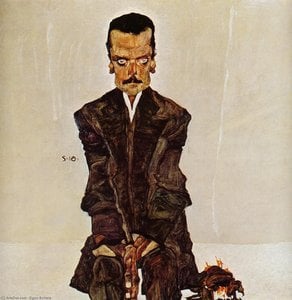
Lilly Steiner
복제본 크기
Egon Schiele’s “Lilly Steiner,” completed in 1918, stands as a haunting testament to the artist's signature style—a masterful blend of psychological intensity and gestural linework that captures the essence of Expressionism. This black crayon sketch depicts two figures: a portrait of Lilly Steiner herself and a smaller figure nestled beneath her gaze, creating an intimate tableau imbued with palpable emotion.
The composition prioritizes verticality, positioning Steiner’s head and shoulders slightly off-center—a deliberate asymmetry that contributes to the artwork's dynamism. Below her, a diminutive form occupies the lower portion of the image, subtly overlapping Steiner’s torso, fostering an unspoken connection between the two subjects. Schiele eschews traditional perspective, flattening the scene and simplifying spatial relationships, reflecting a stylistic choice rooted in conveying inner turmoil rather than realistic representation.
Dominating the artwork is the pervasive use of black ink on white paper—a stark contrast that amplifies the linework’s expressive quality. Lines aren't smooth or uniform; instead, they surge with jagged edges and intersecting contours, mirroring Schiele’s preoccupation with capturing raw emotion. Particularly striking are the intricate lines delineating Steiner’s hair, which writhe and twist in a manner characteristic of Schiele’s technique—a deliberate distortion intended to convey psychological depth.
Organic shapes prevail, mirroring the natural curves of human anatomy. There's no geometric rigidity; instead, forms flow seamlessly across the surface, reflecting Schiele’s belief that art should communicate feeling directly. Texture is suggested through varying densities of linework—darker areas appear richer and more textured than lighter passages—underscoring Schiele’s commitment to tactile representation.
The artwork evokes a profound sense of introspection and vulnerability. Steiner's gaze directs upward, conveying melancholy and contemplation—a visual embodiment of Schiele’s exploration of human emotion. The smaller figure beneath her embodies repose or perhaps resignation, furthering the painting’s contemplative mood. “Lilly Steiner” isn’t merely a depiction of two individuals; it’s an invitation to contemplate themes of mortality, intimacy, and psychological complexity—themes that resonate powerfully within Schiele's broader oeuvre.
Schiele’s work aligns perfectly with Expressionism, prioritizing subjective experience over objective observation. He achieved this remarkable feat through a technique characterized by spontaneous linework and unwavering focus on conveying inner feelings. The meticulous rendering of Steiner’s hair—a deliberate distortion—serves as a microcosm of Schiele's broader artistic vision.
This artwork exemplifies the Expressionist movement's commitment to portraying emotion with uncompromising honesty. Its enduring appeal lies in its ability to capture the essence of human vulnerability and psychological depth—qualities that continue to fascinate art historians and collectors alike.
"Lilly Steiner"의 작가는 에곤 실레입니다. 이 작품은 에곤 실레의 이름으로 등록되어 있습니다.
"Lilly Steiner"을(를) 다운로드하실 수 있습니다: 작품의 디지털 이미지 다운로드 페이지에서 고해상도 디지털 이미지 다운로드 이용이 가능합니다.
"Lilly Steiner"은(는) Expressionism 양식의 작품입니다. 이 사조는 해당 작품이 속한 예술적 전통을 나타냅니다.


1890 - 1918 , 오스트리아 크로아티아

Explore the profound world of Figurative Expressionism. Discover how masters like Munch and Schiele use the human form to convey raw emotion, and learn how to curate these evocative, museum-quality masterpieces for your private collection.

Explore the profound psychological depth of Expressionist portraiture. From Munch to Schiele, discover how distorted forms and visceral brushstrokes unmask raw human emotion in this definitive guide for art enthusiasts and collectors.
 미리보기
미리보기
 공유하기
공유하기 공유하기
공유하기
 상세 정보
상세 정보 가이드 보기

 다운로드
다운로드
 유사 작품 더 보기
 X-레이
X-레이 슬라이드 쇼 보기
 질의응답
질의응답
 통계 정보
통계 정보
 더 보기
더 보기









 유리 옵션은 110cm 미만 크기에서만 선택 가능합니다.