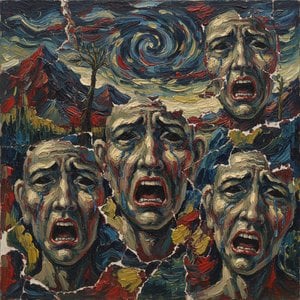
A Portrait of Inner Turmoil: Exploring Edvard Munch’s ‘untitled (9853)’
This captivating portrait by
Edvard Munch offers a compelling glimpse into the artist's exploration of the human psyche. Executed with visible brushstrokes and a restrained palette, ‘untitled (9853)’ is more than just a likeness; it’s an evocation of mood and emotional depth – hallmarks of Munch’s pioneering work in Expressionism.
Subject & Composition
The artwork centers on a woman formally attired in a dark gown, presented in a frontal pose that emphasizes her presence. The composition is deliberately simple, focusing attention entirely on the figure and subtly hinting at an internal world. The hazy, indistinct background of pinkish-brown tones serves not as a setting but as an atmospheric echo of the subject’s emotional state. This deliberate lack of detail directs our gaze to the woman's face and form, inviting us to contemplate her inner life.
Style & Technique
Munch’s technique is immediately recognizable – loose, expressive lines and a layering of oil paint that creates rich texture, particularly in the folds of the gown. The visible brushstrokes aren’t merely descriptive; they *are* the expression, conveying a sense of movement and unrest beneath a veneer of stillness. While rooted in Impressionistic principles of capturing light and atmosphere, ‘untitled (9853)’ pushes beyond mere observation towards an emotional intensity that anticipates the full flowering of Expressionism. The muted color palette – dominated by browns, blacks, and greys – further contributes to this somber mood.
Historical Context & Artistic Lineage
Born in 1863, Munch’s life was profoundly shaped by loss and illness. His childhood experiences—the early deaths of his mother and sister from tuberculosis, coupled with a family history of mental instability—fueled a lifelong preoccupation with themes of mortality, anxiety, and psychological distress. Influenced by the nihilist philosophy he encountered during his artistic training in Kristiania (Oslo), Munch rejected academic conventions to forge a deeply personal style. He sought not to depict the external world accurately, but rather to express *inner* experience – a revolutionary approach that would profoundly influence 20th-century art.
Symbolism & Emotional Impact
The dark gown worn by the subject can be interpreted as symbolic of mourning, introspection, or even repression. Her somber expression suggests a weight of emotion—melancholy, perhaps, or quiet desperation. The painting doesn’t offer easy answers; instead, it invites viewers to project their own feelings and experiences onto the figure. This ambiguity is central to Munch's power as an artist. He wasn’t interested in providing definitive statements but rather in provoking emotional resonance.
Collecting & Interior Design
A reproduction of ‘untitled (9853)’ would serve as a powerful focal point in any collection, particularly for those drawn to Expressionism or Symbolist art. Its muted tones and introspective mood lend themselves well to spaces designed for contemplation and quiet reflection – libraries, studies, or bedrooms. The painting’s emotional depth adds layers of complexity to an interior, sparking conversation and inviting viewers to engage with its haunting beauty.
- Style: Expressionism, Impressionistic elements
- Medium: Oil on canvas
- Key Themes: Mortality, introspection, psychological distress, melancholy
질의응답
에드바르 뭉크의 "untitled (9853)"의 프린트 제품은 어디에서 구매할 수 있나요?
"untitled (9853)" 작품은 코튼 캔버스 또는 아카이브용 캔버스지에 인쇄된 파인 아트 프린트를 통해 만나보실 수 있습니다. 주문은 파인 아트 프린트 페이지에서 원하시는 사이즈를 선택하여 진행하실 수 있습니다.
에드바르 뭉크의 "untitled (9853)"의 권장 인쇄 사이즈는 무엇인가요?
에드바르 뭉크의 "untitled (9853)" 작품은 Large 크기의 복제본을 추천합니다. 비율을 유지하면서 크기를 조정할 수 있습니다.
에드바르 뭉크의 "untitled (9853)"은 어떤 분위기와 감정을 담고 있나요?
"untitled (9853)"은(는) Dramatic 분위기와 함께 Melancholic 감정을 전달합니다.