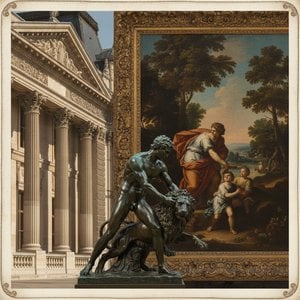
Echo and Narcissus by Pier Francesco Mola: A Baroque Masterpiece
- Artist: Pier Francesco Mola (Il Ticinese)
- Date: Unknown
- Medium: Oil on Canvas (likely, based on similar works)
A Scene of Despair and Reflection
Pier Francesco Mola's "Echo and Narcissus" presents a poignant moment from Greek mythology. The painting depicts Narcissus, a strikingly handsome youth, consumed by his own reflection in a pool of water. He appears to be in distress or discomfort, his head bowed as he gazes at the image before him. The scene is set outdoors, suggested by the trees visible in the background, creating a naturalistic backdrop for this psychological drama. Two dogs are present – one near the left side and another closer to the right – seemingly observing Narcissus with an almost unsettling curiosity. Their presence adds a layer of complexity to the narrative, hinting at a world beyond Narcissus's self-absorption.
Baroque Style and Technique
"Echo and Narcissus" exemplifies the High Baroque style prevalent in 17th-century Rome, where Mola spent much of his career. Mola’s work is characterized by dynamic compositions, dramatic lighting (though subtle here), and a focus on emotional intensity. While known for his frescoes, Mola also excelled in smaller paintings like this one, demonstrating his skill in capturing nuanced expressions and atmospheric detail. The loose style, influenced by Titian, Albani, and Guercino, is evident in the brushwork and the rendering of textures – particularly in the foliage and Narcissus’s garments. The painting likely utilizes oil paints on canvas, a common technique for achieving rich colors and subtle gradations of tone during that period.
Mythological Significance and Symbolism
The subject matter itself is deeply symbolic. The myth of Echo and Narcissus explores themes of vanity, self-love, unrequited love, and the destructive nature of obsession. Narcissus's inability to look beyond his own beauty leads to his demise – he wastes away gazing at his reflection until only a flower remains. Echo, who was cursed to only repeat the words of others, represents lost communication and unattainable desire. Mola’s interpretation focuses primarily on Narcissus’s internal struggle, emphasizing the psychological torment rather than the tragic outcome. The dogs could symbolize fidelity or perhaps even a commentary on the indifference of nature to human suffering.
Emotional Impact and Artistic Legacy
Mola's "Echo and Narcissus" evokes a sense of melancholy and introspection. The painting’s power lies in its ability to convey complex emotions through subtle gestures and facial expressions. The downward gaze, the slumped posture, and the overall atmosphere of quiet despair create a deeply moving image. As a painter active around Rome, Mola's work bridged classicism with looser handling, influencing subsequent generations of artists. Owning a reproduction of this painting offers an opportunity to bring a touch of Baroque drama and timeless beauty into any space, inviting contemplation on the human condition.



 미리보기
미리보기
 손으로 그린 그림 구매
 공유하기
공유하기 공유하기
공유하기
 상세 정보
상세 정보

 다운로드
다운로드
 유사 작품
유사 작품 X-레이
X-레이 슬라이드 쇼
 더 보기
더 보기






































 유리 옵션은 110cm 미만 크기에서만 선택 가능합니다.