


빠른 제작과 다양한 마감 옵션을 제공하는 박물관 수준의 지클레이 및 캔버스 프린트. ( 수작업 채색 복제본 주문하기 디지털 이미지로 전환)
작품의 원본 비율을 그대로 유지하는 프리셋 사이즈 중에서 선택해 보세요.

액자나 벽면 크기에 맞춰 필요한 가로와 세로 길이를 입력해 주세요. 프린트는 원본 이미지보다 크게 제작할 수 없으며 오직 자르는 것만 가능하므로, 비율이 다른 사이즈를 선택할 경우 이미지의 일부가 잘려 나갈 수 있습니다. 인쇄 작업에 들어가기 전, 최종 확인을 위해 디지털 목업을 보내드립니다. 이 페이지에 표시된 이미지는 실제 잘리는 영역을 나타내지 않으며, 오직 목업을 통해서만 정확한 확인이 가능합니다.
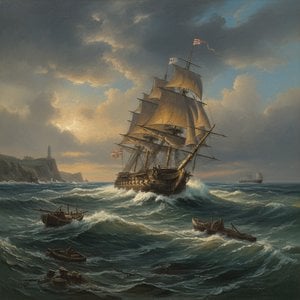
A Sea View
복제본 크기

Born in Glasgow in 1841, Colin Hunter emerged as one of the most evocative voices of the Victorian era, a painter whose soul seemed inextricably linked to the rhythmic pulse of the sea. His early years were shaped by the coastal atmosphere of Helensburgh, where the Firth of Clyde provided a natural classroom for a young boy captivated by the interplay of light and water. Before dedicating himself to the brush, Hunter worked as a clerk in a shipping office, a role that perhaps deepened his intimate understanding of maritime life and the vital connection between humanity and the ocean. This period of observation would later manifest in his canvases as a profound, lived-in realism, far beyond mere academic imitation.
Hunter’s artistic journey was marked by a transition from the structured world of commerce to the boundless freedom of the studio. After leaving his clerical post at twenty, he sought formal training, eventually finding himself in the Parisian studio of Leon Bonnat. While the French influence introduced him to new perspectives on form and light, Hunter remained fundamentally anchored to his Scottish roots. His style evolved into a masterful blend of Luminism and atmospheric realism, where the primary subject was not just the physical landscape, but the very air that moved across it. He possessed a rare ability to capture the ephemeral—the mist clinging to a rugged cliffside, the spray of a breaking wave, or the soft, melancholic glow of dawn over a quiet bay.
The true heart of Hunter’s oeuvre lies in his celebrated seascapes and his tender depictions of coastal communities. He did not merely paint the ocean; he painted the struggle and the serenity of those who lived by its grace. His works often feature the hardworking fisher-folk of the Scottish coast, rendered with a dignity that elevates their daily labors to the level of epic drama. Through subtle gradations of tone and delicate blending, he achieved a sense of movement that makes the water feel alive, capturing both the terrifying dynamism of a storm and the tranquil stillness of a summer morning.
Beyond the shores of Scotland, Hunter’s curiosity led him to explore diverse landscapes, including the breathtaking majesty of Niagara Falls. This versatility demonstrated his ability to adapt his atmospheric technique to different scales of grandeur. His technical prowess was recognized on the global stage, as he exhibited his works in major international arenas such as Berlin, Vienna, and Philadelphia. These exhibitions solidified his reputation as an artist capable of communicating universal emotions through specific, localized scenes.
Hunter’s significance extends beyond his individual canvases to his role within the vibrant artistic community of late 19th-century London. Residing in the prestigious Melbury Road enclave in Kensington, he lived among a circle of esteemed contemporaries, including:
His ascent within the prestigious Royal Academy, becoming an Associate Member in 1884, stands as a testament to his enduring influence and technical mastery. When Colin Hunter passed away in 1904, he left behind a legacy of paintings that serve as windows into a vanished era of maritime tradition. His work remains a profound meditation on the relationship between man and nature, reminding us that even in the most rugged landscapes, there exists a delicate, luminous beauty waiting to be discovered by those who know how to look.

1841 - 1904

Explore the captivating watercolour paintings of William Henry Hunt (1790-1864). Discover his mastery of naturalistic detail, luminous technique & influence on 19th-century art. Learn about collecting Hunt's work and its enduring value.
Explore the captivating world of Thomas Luny (1759–1837), a celebrated British marine artist. Discover his dramatic naval scenes, detailed ship portraits & lasting legacy. Learn about his life, influences & artworks.
 미리보기
미리보기
 공유하기
공유하기 공유하기
공유하기
 상세 정보
상세 정보 가이드 보기

 다운로드
다운로드
 유사 작품 더 보기
 X-레이
X-레이 슬라이드 쇼 보기
 질의응답
질의응답
 통계 정보
통계 정보

 더 보기
더 보기






































 유리 옵션은 110cm 미만 크기에서만 선택 가능합니다.


