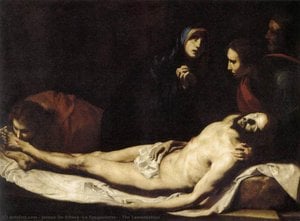
A Moment Frozen in Time: The Emotional Resonance of Le Brun’s Pietà
In the hallowed stillness of the Musée du Louvre, there exists a canvas that does more than merely depict a biblical event; it captures the very essence of human grief. Charles Le Brun’s Pietà, painted in 1643, is a monumental achievement of the Baroque era, serving as a profound meditation on sorrow, faith, and the weight of mortality. Originally commissioned for the Sainte-Chapelle in Paris—a sanctuary dedicated to the relics of Christ—this oil on canvas was designed to evoke spiritual contemplation through its sheer emotional gravity. As viewers encounter the work, they are not just observing a scene from the Passion; they are invited into a sacred space where the boundaries between the divine and the human dissolve.
The painting centers on the poignant aftermath of the crucifixion, presenting the Virgin Mary cradling the lifeless form of her son. Le Brun masterfully employs a pyramidal composition, a technique that provides a sense of structural stability to an otherwise turbulent emotional scene. This geometric arrangement directs the eye upward, guiding the observer from the heavy, slumped weight of Christ’s body toward the serene yet heartbroken countenance of Mary. The interplay of light and shadow, known as chiaroscuro, is utilized with breathtaking precision. A singular, dramatic light source illuminates the central figures against a dark, indistinct background, stripping away all worldly distractions to focus the soul entirely on the tragedy unfolding within the frame.
Mastery of Technique and the Baroque Spirit
To understand the Pietà is to understand the hand of Charles Le Brun, a titan of French art who shaped the aesthetic standards of the age. His technique reflects the rigorous training he received under masters like Simon Vouet and his transformative years in Rome alongside Nicolas Poussin. In this work, Le Brun achieves a perfect balance between dramatic realism and idealized beauty. The texture of the painting is remarkably rich; one can almost feel the heavy, flowing drapery of Mary’s robes as they cascade around the figures, adding a sense of dynamic movement to the stillness of death. His brushwork captures the subtle nuances of skin, the limpness of muscle, and the intricate folds of fabric, all rendered with an exacting detail that speaks to his mastery of the medium.
Beyond its technical brilliance, the artwork serves as a profound symbolic vessel. The scene is steeped in Christian iconography, representing the ultimate sacrifice and the enduring devotion of the faithful. The presence of figures like Joseph of Arimathea and Mary Magdalene adds layers of communal mourning, yet the focus remains on the intimate bond between mother and son. For the collector or the lover of fine art, this piece offers more than just visual splendor; it provides a window into the 17th-century French soul. It is an ideal centerpiece for those seeking to infuse a space with historical depth, intellectual rigor, and a sense of timeless, quiet majesty.
질의응답
샤를 르 브륄의 "Pietà"은 어디에서 다운로드할 수 있나요?
샤를 르 브륄의 "Pietà"은(는) 디지털 이미지로 고해상도 디지털 이미지 다운로드할 수 있으며, 작품의 다운로드 페이지에서 다운로드 가능합니다.
"Pietà"은 어떤 색채와 어떤 감정을 담아내고 있나요?
샤를 르 브륄의 "Pietà"은(는) Earthy 색조의 팔레트와 Melancholic 분위기가 조화를 이룹니다.
"Pietà"은(는) 샤를 르 브륄의 작품 세계에서 어떤 위치를 차지하고 있나요?
"Pietà"은(는) 샤를 르 브륄의 다른 작품들과 마찬가지로 Baroque 양식과 더불어 baroque grandeur & emotion, catholic faith & devotion, royal patronage & spectacle, le brun's academic style, monumental religious scenes, french court art influence, exploring human suffering, key work showcasing skill라는 작가의 반복되는 주제 의식을 공유합니다.