

이 페이지에 표시된 작품은 저작권법의 보호를 받으며, 이에 따라 동일한 복제품을 제작하거나 판매하는 것은 법으로 금지되어 있습니다. 이러한 권리 보호는 다음과 같은 국제 협약에 따라 시행됩니다. 베른 협약 또한 다음에서 명시하는 법률을 포함한 국내법에 의해 보호됩니다. 미국 저작권법 제17조.
이 방식은 저작권 보호를 받는 예술 작품을 복제하거나 그대로 재현하는 것이 아니기에 저작권 규정을 완벽히 준수합니다. 대신, 이는 창의적인 재해석의 과정을 거칩니다. 즉, 원작에서 영감을 받되 원작과 동일하지 않은 새로운 회화 작품을 의미합니다.
빠른 제작과 다양한 마감 옵션을 제공하는 박물관 수준의 지클레이 및 캔버스 프린트. ( 수작업 채색 복제본 주문하기 디지털 이미지로 전환)
작품의 원본 비율을 그대로 유지하는 프리셋 사이즈 중에서 선택해 보세요.

액자나 벽면 크기에 맞춰 필요한 가로와 세로 길이를 입력해 주세요. 프린트는 원본 이미지보다 크게 제작할 수 없으며 오직 자르는 것만 가능하므로, 비율이 다른 사이즈를 선택할 경우 이미지의 일부가 잘려 나갈 수 있습니다. 인쇄 작업에 들어가기 전, 최종 확인을 위해 디지털 목업을 보내드립니다. 이 페이지에 표시된 이미지는 실제 잘리는 영역을 나타내지 않으며, 오직 목업을 통해서만 정확한 확인이 가능합니다.
Untitled
복제본 크기

In the vibrant, often turbulent landscape of twentieth-century German abstraction, few names resonate with as much intrigue and stylistic purity as Blinky Palermo. Born Peter Schwarze in Leipzig in 1943, the artist’s very identity was a carefully constructed performance. Adopted as an infant alongside his twin brother, Michael, by the Heisterkamp family, he would later adopt a pseudonym that sounded more like a character from a noir film than a scholar of the fine arts. This moniker, taken from the American boxing promoter and mafioso Frank "Blinky" Palermo, signaled a departure from the traditional and an embrace of the provocative. During his formative years at the Kunstakademia Düsseldorf between 1962 and 1967, studying under luminaries such as Joseph Beuys and Bruno Goller, he began to strip away the unnecessary, seeking a visual language that relied on the raw power of color and spatial tension.
Palermo’s artistic evolution was marked by a relentless pursuit of the essential. Moving away from the heavy, gestural traditions of previous eras, he became a master of the minimalist gesture. His work often bypassed the conventional canvas entirely, opting instead for unconventional surfaces that challenged the viewer's perception of what constitutes a painting. He experimented with aluminum, steel, wood, paper, and even Formica, frequently utilizing tape to create precise, sharp lines that functioned as much as architectural elements as they did artistic marks. This fascination with the physical properties of his medium allowed him to explore the organized spatial relationship between form and color—a polarity that became the heartbeat of his entire oeuvre.
The true genius of Palermo lay in his ability to transform simple materials into profound aesthetic experiences. He is perhaps most celebrated for his "fabric paintings," a technique where lengths of colored material were meticulously cut, stitched, and stretched over frames. These works possessed a tactile, sculptural quality that bridged the gap between two-dimensional painting and three-dimensional object. His repertoire of shapes was equally daring; he moved beyond the rectangular confines of traditional art to embrace circles, triangles, cruciforms, and even totem-like vertical strips. One might look at his Untitled (Totem) from 1964 and see not just a piece of wood, but a primitive ladder of color, punctuated by white and blue elements that command the surrounding space.
His influences were as profound as they were diverse, drawing strength from the radical simplicity of Kazimir Malevich and the expansive color fields of Barnett Newman and Ellsworth Kelly. From these masters, he inherited a respect for the monochrome and a belief that a single, well-placed hue could evoke an entire universe of emotion. His work was never merely about decoration; it was an investigation into how light, color, and edge interact within a defined space. Whether working in the spare, monochromatic depths of his canvases or the bold, geometric precision of his tape-based works, Palermo maintained a sense of rhythmic balance that felt both modern and timeless.
Despite a career that was tragically brief, Blinky Palermo left an indelible mark on the trajectory of contemporary abstraction. His life was marked by a restless movement—from the studios of Düsseldorf to the bustling energy of New York, and eventually to the quietude of Mönchengladbach, where he shared creative spaces with artists like Imi Knoebel and Ulrich Rückriem. However, this period of intense productivity was shadowed by personal struggles. His death in 1977, at the young age of 33 during a trip to the Maldives, remains a poignant moment in art history, often whispered about in the context of his turbulent lifestyle.
Today, Palermo is remembered not just as a figure of mystery, but as a pioneer of Minimalism and Conceptual art. His ability to find beauty in the most basic elements—a strip of cloth, a piece of tape, a single color—continues to inspire those who seek truth in simplicity. He remains a vital part of the Düsseldorf School's legacy, a painter who dared to redefine the boundaries of the frame and invited us to see the profound architecture hidden within the simplest of forms.

1943 - 1977 , Germany
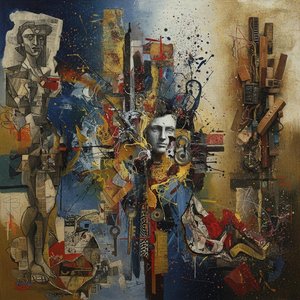
Journey through history with 10 iconic mixed media masterpieces that redefined modern art. Explore the stories, textures, and techniques behind these legendary works. Find museum-quality reproductions and curated decor inspiration at WahooArt.com. Discover all masterpieces online.

베니스 비엔날레 최고 명작 25선을 만나보세요. 유명 화가들의 숨겨진 이야기와 추상화, 모던 아트 등 예술 작품의 깊이를 탐구합니다. WahooArt에서 고품질 미술 컬렉션을 감상하고 특별한 인테리어를 완성하세요! 지금 바로 온라인으로 둘러보기.

Immerse yourself in the profound emotion of Abstract Expressionism. Explore our curated guide to the top 25 Mark Rothko masterpieces, from iconic color field paintings to museum-quality reproductions for your decor. Discover all masterpieces on WahooArt.com.

Explore 10 iconic graphite masterpieces that redefined art history. Discover museum-quality legends on WahooArt.com.

Explore 10 defining masterpieces of contemporary art – from Jeff Koons to Yayoi Kusama. Discover the stories behind iconic paintings & sculptures, and find museum-quality reproductions for your home at WahooArt.com. Explore the full collection online!
 미리보기

 공유하기
 공유하기
 상세 정보
 가이드 보기


 다운로드
 유사 작품 더 보기
 X-레이
 슬라이드 쇼 보기
 질의응답

 통계 정보
 더 보기






































 유리 옵션은 110cm 미만 크기에서만 선택 가능합니다.


