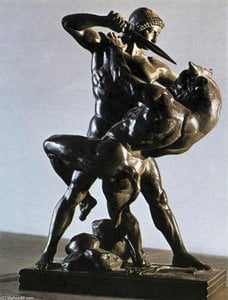
Benvenuto Cellini’s Perseus with the Head of Medusa: A Renaissance Triumph
Benvenuto Cellini’s sculpture “Perseus with the Head of Medusa,” created between 1545 and 1554 for the Loggia dei Lanzi in Florence, stands as a monumental testament to Mannerist artistry—a period characterized by dramatic flair and stylistic complexity that followed the High Renaissance. More than just a depiction of mythic heroism, Cellini’s masterpiece embodies the intellectual fervor and artistic ambition of its time, cementing Cellini's place among the foremost sculptors of his era.
The Myth Embodied in Bronze
The sculpture portrays Perseus, the legendary hero who slew Medusa—a Gorgon whose gaze turned men to stone—for King Polydectes. Cellini meticulously captured the decisive moment after Perseus decapitated Medusa, holding aloft her severed head by her hair with unwavering strength and determination. The pose itself is imbued with dynamism – Perseus’s raised right arm conveys triumph, while his musculature reflects the physical exertion required for this perilous feat.
Technique and Material: A Masterpiece of Bronze Craftsmanship
Cellini employed bronze—a material prized for its durability and ability to capture intricate detail—to achieve an astonishing level of realism. The sculptor skillfully hammered the metal into form, utilizing techniques honed over decades of experience. Careful observation reveals subtle nuances in musculature and facial expression, demonstrating Cellini’s profound understanding of human anatomy. Furthermore, the sculpture's surface is polished to a gleaming sheen, enhancing its visual impact and conveying an aura of grandeur.
Symbolism: Triumph Over Monstrosity and Divine Inspiration
Beyond its narrative depiction of Perseus’s victory, “Perseus with the Head of Medusa” resonates with deeper symbolic meanings. The Gorgon's head represents evil and terror—forces that Perseus vanquishes through courage and intellect. Cellini’s masterful rendering underscores the triumph of reason over primal fear. Moreover, the sculpture is considered to be inspired by classical ideals of beauty and heroism – a reflection of the humanist spirit prevalent during the Renaissance.
A Legacy Enduring Through Time
“Perseus with the Head of Medusa” remains one of Cellini’s most celebrated works—a cornerstone of Florentine sculpture and an exemplar of Mannerist style. Its enduring appeal lies in its ability to convey both physical prowess and intellectual conviction, capturing the essence of Renaissance ambition and artistic excellence. Today, reproductions of this iconic sculpture continue to inspire admiration for Cellini's unparalleled skill and his contribution to the artistic heritage of Italy.
질의응답
베누토 체리니의 "Perseus"은(는) 퍼블릭 도메인에 해당하나요? 그 이유는 무엇인가요?
"Perseus"의 저작권 상태(퍼블릭 도메인 - 저작권 보호 기간이 만료되었습니다)는 작가의 1571년 사망 시점을 기준으로 결정됩니다.
Perseus의 제작 연도인 1540년은 베누토 체리니의 예술적 경력 중 어느 시기에 해당하나요?
1540년에 제작된 "Perseus"은 베누토 체리니의 예술적 발전 과정 중 Renaissance에 해당합니다.
"Perseus"은(는) 베누토 체리니의 반복되는 주제들 사이에서 어떤 위치를 차지하고 있나요?
베누토 체리니의 주요 주제인 classical greek ideals, mythological narrative, power & heroism themes, cellini's self-promotion, renaissance sculpture mastery, medusa's vengeful story, florentine artistic pride, artist's personal legend 중에서도, "Perseus"은 mythological figure, greek mythology, medusa's head, perseus victory, bronze sculpture, renaissance art, classical hero에 독자적인 초점을 맞추고 있습니다.