x


빠른 제작과 다양한 마감 옵션을 제공하는 박물관 품질의 지클레이 또는 캔버스 프린트. ( 손으로 그린 그림 구매 이미지 구매)
작품의 원본 비율을 유지하는 미리 설정된 크기 중에서 선택하세요.

특정 프레임이나 공간에 맞춰 직접 치수를 입력하실 수 있습니다. 선택하신 사이즈가 원본 이미지의 비율과 일치하지 않을 경우, 작품을 크롭(자르기)하거나 이미지를 대칭 또는 단색 채우기로 확장하여 제작합니다. 제작 시작 전, 최종 확인을 위해 디지털 목업이 전송됩니다.
화면상의 미리보기는 실제 크롭이나 확장 상태를 반영하지 않으므로, 최종 구도는 오직 목업을 통해서만 정확하게 확인하실 수 있습니다.
맞춤 사이즈 제작도 가능하지만, 원본 비율을 유지하기 위해서는 사전 정의된 목록에서 치수를 선택하시는 것을 권장합니다.

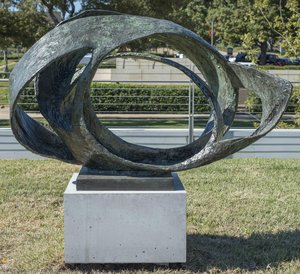
Shaft and Circle
복제본 크기
Barbara Hepworth's "Shaft and Circle," created in 1972, isn’t merely a sculpture; it’s an invitation to quiet contemplation. Standing before this arresting form – a towering shaft of polished concrete punctuated by a perfectly circular aperture – is akin to entering a sacred space. The piece immediately commands attention with its stark simplicity and the profound sense of upward movement it evokes. Hepworth, a pivotal figure in 20th-century British sculpture, masterfully distilled her signature style into this work: an exploration of form’s inherent qualities, divorced from representational concerns. It's a testament to her belief that sculpture could be experienced not just visually, but through touch and the subtle shifts in light and shadow.
The material itself – likely cast concrete, though Hepworth often worked with stone as well – is treated with an almost reverent attention. The surface is flawlessly smooth, reflecting the surrounding environment while simultaneously maintaining a sense of contained solidity. This deliberate contrast between smoothness and mass speaks to the core of Hepworth’s philosophy: she sought to capture the essence of materials themselves, revealing their inherent textures and geometries. The scale of the sculpture – approximately six feet tall – further amplifies this effect, drawing the viewer upwards into its embrace.
To fully appreciate “Shaft and Circle,” it’s crucial to understand Hepworth's artistic lineage. Her early influences stemmed from her travels through Italy and Greece, particularly a deep immersion in the archaeological sites of Mycenae. The shaft tomb tradition prevalent in Bronze Age Greece – elaborate burial chambers dug vertically into the earth, often containing grave goods – provided a foundational inspiration for her work. These tombs, built by elite societies, weren’t simply markers of death; they were statements of power and belief, reflecting a complex cosmology centered around ancestry and the afterlife. Hepworth's sculpture echoes this spirit, suggesting an upward journey towards something beyond the material world.
Interestingly, similar shaft tombs have been found in Bronze Age China, demonstrating a surprisingly widespread cultural practice across Eurasia. This shared heritage underscores the universal human impulse to create enduring monuments and explore questions of mortality and transcendence. Hepworth’s work can be seen as a contemporary reimagining of these ancient traditions, translated into the language of abstract form.
The composition of “Shaft and Circle” is meticulously balanced between two fundamental principles: verticality and circularity. The shaft itself rises directly upwards, creating a powerful sense of momentum and aspiration. This upward thrust is counterbalanced by the perfectly formed circle cut into its midsection – an element that introduces ambiguity and invites interpretation. The circle can be seen as representing wholeness, continuity, or perhaps even a portal to another dimension. It’s a subtle yet potent symbol that adds layers of meaning to the sculpture's overall impact.
Hepworth was deeply interested in exploring the relationship between form and space. She believed that sculpture should not simply occupy physical space but also create an emotional resonance within the viewer. “Shaft and Circle” achieves this beautifully, prompting a sense of stillness and introspection. The negative space created by the circular aperture is just as important as the solid mass of the shaft itself, contributing to the sculpture’s dynamic balance.
“Shaft and Circle” exemplifies Hepworth's commitment to minimalism and her profound understanding of materials. It’s a work that rewards careful observation and invites repeated contemplation. Her sculptures, often described as “non-objective,” are nonetheless deeply expressive, communicating complex ideas about form, space, and the human condition. Today, "Shaft and Circle" remains a powerful testament to Hepworth's artistic vision – a timeless exploration of fundamental geometric principles and their capacity to evoke profound emotional responses.


1903 - 1975 , 영국

몬드리안, 말레비치 등 거장들의 기하학적 추상 미술 명작 10선을 만나보세요. 각 작품의 예술사적 의미와 색채, 구성을 탐구하고 WahooArt.com에서 고품질 아트 프린트를 소장하세요. 지금 바로 온라인 컬렉션을 확인하세요!

Explore the profound world of Barbara Hepworth's sculpture. Discover her artistic evolution, iconic forms, and lasting influence on modern art. A guide for collectors & enthusiasts.

Journey through Wassily Kandinsky's 25 most iconic abstract paintings. Explore his revolutionary use of color, form & spiritual expressionism. Find museum-quality Kandinsky reproductions and elevate your home decor with WahooArt.com. Discover all masterpieces on WahooArt.com!

페르낭 레제의 최고 걸작 25선을 만나보세요. 큐비즘, 추상 미술의 거장이 그린 명작들의 탄생 비화와 예술적 의미를 탐구합니다. WahooArt에서 고품질 아트 프린트와 인테리어 액자로 공간에 예술을 더하세요. 지금 바로 컬렉션을 확인하세요!

Explore the evolution of geometric abstraction from Cubism to contemporary art. Discover key artists like Malevich & Mondrian, investment insights, and expert collecting advice at WahooArt.


최신 미술 뉴스, 특별 혜택 및 인테리어 아이디어를 가장 먼저 만나보세요.
프로젝트에 대해 알려주시면 저희 미술 전문가들이 맞춤형 아트 제안 3가지를 전달해 드립니다.
당신만을 위한 맞춤형 옵션 3가지를 무료로 추천해 드립니다!


 공유하기
공유하기 공유하기
공유하기
 상세 정보
상세 정보

 다운로드
다운로드
 유사 작품
유사 작품 슬라이드 쇼


 더 보기
더 보기






































 유리 옵션은 110cm 미만 크기에서만 선택 가능합니다.