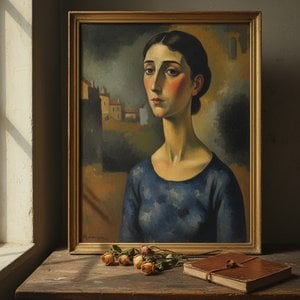
The Enigmatic Figure: An Introduction to “Untitled (926)”
Amedeo Clemente Modigliani's "Untitled (926)" is not merely a depiction of a woman; it’s an immersion into a world of quiet contemplation and subtle yearning. Painted in the early 1920s, during a period of intense personal struggle for the artist, this work embodies his signature style – elongated forms, expressive eyes, and a hauntingly beautiful aesthetic that continues to captivate viewers today. The painting presents a woman seated comfortably in a chair, her arms resting languidly on a table or countertop. While her face remains partially obscured by shadow, a sense of profound serenity emanates from her posture, suggesting an inner peace amidst the turmoil of Modigliani’s life. The composition is deliberately balanced, drawing our attention to the central figure while incorporating elements – perhaps a glimpse of drapery or a suggestion of surrounding space – that contribute to a feeling of depth and quiet drama.
Expressionist Lines and the Language of Form
Modigliani’s artistic language is immediately recognizable in “Untitled (926).” Bold, decisive lines define the figure's elongated neck and limbs, a hallmark of his style that departs significantly from traditional portraiture. These exaggerated proportions aren’t simply stylistic flourishes; they serve to heighten emotional impact, conveying a sense of vulnerability and timelessness. The use of simplified shapes – the rounded head, the subtly curved torso – creates an almost sculptural quality, reminiscent of ancient Greek statuary while simultaneously embracing a distinctly modern sensibility. The painting's expressionist leanings are evident in the deliberate distortion of form, used to communicate inner states rather than literal representation. Notice how the shadows play across her face and body, adding layers of mystery and inviting speculation about her thoughts and feelings.
A Portrait of a Troubled Soul: Contextualizing the Work
Understanding the context surrounding “Untitled (926)” is crucial to appreciating its emotional resonance. Modigliani’s life was marked by profound personal challenges – chronic illness, financial instability, and a heartbreaking love affair with Jeanne Hébuterne. He struggled with tuberculosis throughout much of his adult life, and his relationships were often fraught with difficulty. Despite this, he continued to create powerfully evocative works that explored themes of beauty, melancholy, and the fragility of human existence. This painting can be interpreted as a reflection of Modigliani’s own internal landscape – a yearning for stability and connection amidst a world of uncertainty. The woman's gaze, though partially hidden, seems to hold both sadness and acceptance, mirroring the artist’s complex emotional state.
Symbolism and the Allure of the Unseen
The deliberate obscuring of the woman’s face is not a flaw but a deliberate artistic choice. It invites viewers to project their own emotions and interpretations onto the figure, transforming her into a universal symbol of introspection and quiet contemplation. The setting – a simple chair and table – further emphasizes this sense of isolation and inner focus. The muted color palette—primarily browns, ochres, and subtle blues—contributes to the painting’s somber mood, reinforcing the feeling of melancholy that permeates the work. Modigliani's skill lies in his ability to convey profound emotion through suggestion rather than explicit representation, leaving much open to the viewer’s imagination.
Explore a high-quality hand-painted reproduction of “Untitled (926)” today at WahooArt.com and bring this iconic work of art into your home or office.
질의응답
모딜리아니의 "untitled (926)"의 어떤 프린트 사이즈가 추천된 공간에 잘 어울릴까요?
Living Room 공간에는 "untitled (926)" 작품을 Medium 크기로 인쇄하여 배치하는 것을 추천합니다.
모딜리아니의 "untitled (926)"의 전반적인 분위기는 어떠한가요?
"untitled (926)"은(는) Romantic 분위기를 자아냅니다.
모딜리아니의 "untitled (926)"의 색감을 고려했을 때, 어떤 공간에 배치하는 것이 가장 좋을까요?
모딜리아니의 "untitled (926)"의 Neutrals 색조는 추천 공간인 Living Room(으)로 완벽하게 어우러집니다.