
x


 Surrealism
 2008
2008 143.0 x 201.0 cm
빠른 제작과 다양한 마감 옵션을 제공하는 박물관 품질의 지클레이 또는 캔버스 프린트. ( 손으로 그린 그림 구매 이미지 구매)





























작품의 원본 비율을 유지하는 미리 설정된 크기 중에서 선택하세요.

특정 프레임이나 공간에 맞춰 직접 치수를 입력하실 수 있습니다. 선택하신 사이즈가 원본 이미지의 비율과 일치하지 않을 경우, 작품을 크롭(자르기)하거나 이미지를 대칭 또는 단색 채우기로 확장하여 제작합니다. 제작 시작 전, 최종 확인을 위해 디지털 목업이 전송됩니다.
화면상의 미리보기는 실제 크롭이나 확장 상태를 반영하지 않으므로, 최종 구도는 오직 목업을 통해서만 정확하게 확인하실 수 있습니다.
맞춤 사이즈 제작도 가능하지만, 원본 비율을 유지하기 위해서는 사전 정의된 목록에서 치수를 선택하시는 것을 권장합니다.

Zero
복제본 크기

Born in New York City in 1960, Jean-Michel Basquiat’s life was tragically cut short at the age of 27, yet his impact on the art world remains profound. He emerged from the vibrant and rebellious crucible of the late 1970s and early 1980s New York City – a period defined by burgeoning street art, punk rock energy, and a growing awareness of social injustice. His work wasn’t simply painting; it was an urgent, raw expression of experience, grappling with themes of race, class, power, and identity.
Basquiat's early career began not in formal studios but on the streets as “SAMO,” a graffiti artist alongside Al Diaz. Together they plastered Manhattan’s Lower East Side with enigmatic epigrams – short, provocative phrases that challenged societal norms and questioned authority. This street art foundation provided a crucial understanding of visual language and an immediate connection to the city's marginalized communities. It was during this period that Basquiat began to develop his distinctive style, incorporating text and image in ways that were both visually arresting and intellectually stimulating.
By the early 1980s, Basquiat’s work transitioned from street art to gallery exhibitions. He quickly became a central figure in the neo-expressionist movement, a reaction against the minimalist trends of the preceding decade. Unlike the cool detachment of earlier movements, neo-expressionism embraced emotional intensity and subjective experience. Basquiat's paintings were characterized by bold colors, fragmented figures, and layers of text – often incorporating historical references, personal anecdotes, and social commentary.
His artistic vocabulary was remarkably eclectic, drawing inspiration from a wide range of sources: classical art, African masks, jazz music, poetry, and the history of race in America. He frequently referenced his own heritage as a mixed-race individual, exploring themes of identity and belonging within a society grappling with its past. The influence of figures like Duke Ellington and Langston Hughes is evident in his use of rhythm and imagery.
Basquiat’s work consistently tackled complex and often uncomfortable subjects. He confronted issues of racial inequality, poverty, and the corrupting influence of power structures. His paintings frequently depicted skulls – a recurring motif symbolizing mortality and the fragility of life – alongside images of wealth, luxury, and social disparity. The juxtaposition of these elements created a powerful critique of American society.
Technically, Basquiat’s style was remarkably diverse. He employed a range of techniques, including painting, drawing, collage, and assemblage. His works often featured layers of paint applied with both precision and spontaneity, creating textured surfaces that invited close examination. He frequently incorporated text directly onto the canvas, using it not merely as decoration but as an integral part of the artwork’s meaning. The use of found objects and mixed media further enhanced the complexity and immediacy of his work.
Despite his tragically short life, Jean-Michel Basquiat achieved remarkable recognition during his lifetime. He became the youngest artist to participate in Documenta 7 in Kassel, Germany (1982), and one of the youngest to exhibit at the Whitney Biennial in New York (1982). His work was exhibited internationally, solidifying his place as a major figure in contemporary art.
Following his death from a heroin overdose in 1988, Basquiat’s market value soared. Today, his paintings are among the most valuable and sought-after works of art in the world. His legacy extends beyond the financial realm; he remains an important voice for social justice and a powerful example of how art can be used to challenge conventional thinking and provoke meaningful dialogue. His work continues to resonate with audiences today, reminding us of the urgent need for empathy, understanding, and critical engagement with the complexities of our world.

1988 - , Democratic Republic of the Congo

Master the nuances of Giclée printing with our expert guide. Discover how pigment-based inks and museum-grade substrates create fade-resistant, high-fidelity art reproductions designed for discerning collectors seeking unparalleled quality and longevity.
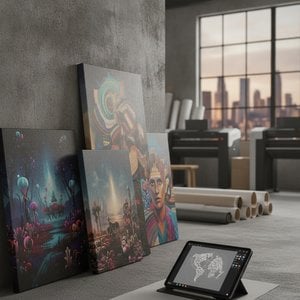
당신의 예술적 영감을 전 세계로 확장하세요. WahooArt는 재고 부담 없는 프리미엄 지클리(Giclée) 프린트 솔루션을 통해 인플루언서와 작가들에게 글로벌 비즈니스 기회를 제공합니다. 박물관급 품질의 파인 아트 프린팅과 투명한 물류 시스템으로 당신의 작품을 시대를 초월한 예술적 유산으로 완성해 드립니다.


최신 미술 뉴스, 특별 혜택 및 인테리어 아이디어를 가장 먼저 만나보세요.
프로젝트에 대해 알려주시면 저희 미술 전문가들이 맞춤형 아트 제안 3가지를 전달해 드립니다.
당신만을 위한 맞춤형 옵션 3가지를 무료로 추천해 드립니다!


 미리보기
미리보기
 공유하기
공유하기 공유하기
공유하기
 상세 정보
상세 정보

 다운로드
다운로드
 유사 작품
유사 작품 X-레이
X-레이 슬라이드 쇼
 더 보기
더 보기









 유리 옵션은 110cm 미만 크기에서만 선택 가능합니다.


