

 Contemporary Realism
 1986
1986 66.0 x 48.0 cm
 The Ramzi and Saeda Dalloul Art Foundation
작가가 직접 캔버스에 손으로 그린 유화 작품으로, 원하는 크기와 액자로 맞춤 제작해 드립니다. ( 프린트 판매로 전환 디지털 이미지 판매 채널로 전환)
작품의 원본 비율을 그대로 유지하는 프리셋 사이즈 중에서 선택해 보세요.

특정 프레임이나 공간에 맞춰 원하는 크기를 직접 입력하실 수 있습니다. 선택하신 크기가 원본 이미지의 비율과 일치하지 않을 경우, 작품을 자르거나 추가적인 수작업 요소를 더해 그림을 확장하여 제작합니다. 제작 시작 전, 최종 확인을 위해 디지털 목업을 보내드립니다.
화면상의 미리 보기는 실제 크롭(자르기)이나 확장된 상태를 완벽히 반영하지 않을 수 있습니다. 최종 구도는 오직 목업을 통해서만 정확하게 확인하실 수 있습니다.
맞춤 크기 제작도 가능하지만, 원본의 비율을 그대로 유지하기 위해서는 미리 정의된 목록에서 크기를 선택하시는 것을 권장합니다.

Leda
복제본 규격

In the quiet village of Rachana, Lebanon, a landscape steeped in the ancient echoes of Phoenician heritage, Alfred Basbous el-Rachani began a journey that would eventually redefine the boundaries of Middle Eastern modernism. Born in 1924, the son of a Christian cleric, Basbous’s early life was imbued with a sense of spiritual depth and an appreciation for the sacredness of form. Before he ever touched the delicate surfaces of marble or the molten heat of bronze, his hands were acquainted with the rugged reality of stone through his work as a mason for a railroad company. This foundational period of manual labor proved far from incidental; it instilled in him a profound, tactile understanding of material, a respect for the weight and resistance of earth, and a mastery of the very substances that would later become his medium for poetic expression.
As his artistic sensibilities matured, Basbous transitioned from the practicalities of masonry to the evocative realm of sculpture, driven by an innate desire to capture the essence of life. His early explorations were marked by a meticulous observation of the natural world—the sinuous curves of reptiles and the graceful silhouettes of birds—themes that would eventually merge with his lifelong fascination for the female nude. For Basbous, the human body was not merely a subject for representation but a vessel for abstraction. He sought to strip away the superfluous, discarding any ornamentation he deemed frivolous to reveal a core of elemental truth and simplicity. His work became a dialogue between the tangible and the ethereal, where the solid weight of stone could suggest the lightness of breath.
The trajectory of Basbous’s career was significantly shaped by his exposure to the giants of European modernism. Supported by a prestigious scholarship from the French government in 1960, he traveled to Paris to study at l’École nationale des beaux-arts under the guidance of René Collmarini. It was within this international artistic discourse that his vision crystallized, drawing profound inspiration from the reductive aesthetics of Constantin Brâncuși and the organic, spatial explorations of Henry Moore. The influence of Jean Arp’s geometric abstraction also left an indelible mark on his practice, encouraging him to embrace a language of fluid, biomorphic shapes that felt both ancient and avant-garde.
Yet, despite these international influences, Basbous remained deeply rooted in the cultural soil of Lebanon. His sculptures are permeated by the spirit of Phoenician culture and the subtle iconography of the Maronite Church, creating a unique aesthetic synthesis. He possessed a rare ability to weave together the geometric precision of modern abstraction with the flowing, organic traditions of Lebanese folk art. This duality allowed his work to resonate on multiple levels: as a sophisticated contribution to global modernism and as a profound celebration of Levantine identity. Whether working in bronze, wood, metal, or stone, his pieces—such as the serene Leda—embody a timelessness that transcends geographical borders.
Throughout his prolific career, which spanned from his first exhibition at the Alecco Saab Gallery in Beirut in 1958 until his passing in 2006, Basbous achieved remarkable recognition. His works were not only celebrated within the Middle East but also graced the prestigious halls of the Musée Rodin in Paris and the Hakone Open-Air Museum in Japan. This global reach solidified his status as a pioneer who brought the language of modern sculpture to the Arab world, proving that local heritage could serve as a powerful foundation for universal artistic expression.
The enduring significance of Alfred Basbous el-Rachani lies in his ability to achieve aesthetic purity. His legacy is found in the following hallmarks of his oeuvre:
Today, Basbous is remembered not just as a sculptor, but as a visionary who bridged the gap between the ancient and the modern, leaving behind a body of work that continues to breathe with the vitality of the natural world.

1924 - 2006 , Lebanon

Discover the enduring allure of bronze sculptures at WahooArt.com. From classical lost-wax casting to modern metal masterpieces, explore museum-quality artworks designed to elevate luxury interiors. Expert curation, authenticity guaranteed, and worldwide shipping for discerning collectors.

Discover the enduring allure of bronze sculpture. From the intricate lost-wax process to Neoclassical masterpieces, our expert guide offers connoisseurs deep insights into evaluating patina, historical significance, and integrating metal fine art into sophisticated collections.
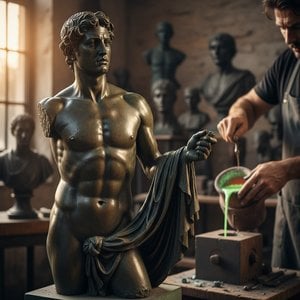
Discover the enduring elegance of bronze sculpture. From ancient Roman strength to Art Deco sophistication, explore our expert guide on collecting, casting techniques, and integrating timeless metal masterpieces into your fine art collection.

 실제 크기로 보기
 보내기
보내기 공유하기
공유하기
 상세 보기
상세 보기 가이드 보기

 이미지 다운로드
 유사 작품 더 보기
 X-레이
X-레이 슬라이드 쇼 보기
 통계 정보
통계 정보 상세 보기
상세 보기






































 유리 옵션은 110cm 미만 크기에서만 선택 가능합니다.


