

 Dutch Golden Age
 1735Early Modern
 40.0 x 49.0 cm
 에르미타주 박물관
작가가 직접 캔버스에 손으로 그린 유화 작품으로, 원하는 크기와 액자로 맞춤 제작해 드립니다. ( 프린트 판매로 전환 디지털 이미지 판매 채널로 전환)





























작품의 원본 비율을 그대로 유지하는 프리셋 사이즈 중에서 선택해 보세요.

액자나 벽면 크기에 맞춰 필요한 가로와 세로 길이를 입력해 주세요. 본 작품은 수작업으로 제작되므로, 요청하신 비율에 따라 작가가 그림의 가장자리를 조금 더 넓게 그리거나 일부를 조정하여 작업할 수 있습니다. 작업 시작 전, 최종 확인을 위해 디지털 목업 이미지를 보내드립니다. 이 페이지에 표시된 이미지는 실제 결과물과 다를 수 있으며, 오직 목업 이미지만이 정확한 결과물을 보여줍니다.
Shoemaker
복제본 규격
In the delicate brushstrokes of Aert Schouman’s 1735 masterpiece, Shoemaker, we are transported into the heart of a private, mid-eighteenth-century social gathering. This evocative scene captures a quiet moment of human connection, where the boundaries between domestic life and social ritual blur seamlessly. The composition centers on a group of figures gathered around a table, their postures suggesting a deep, unhurried engagement in conversation. A seated woman serves as the emotional anchor of the piece, her presence grounding the surrounding men who stand in attentive, perhaps even contemplative, stances. Through Schouman’s lens, we do not merely observe a room; we eavesdrop on a moment of shared history, feeling the warmth of the candlelight and the weight of the unspoken words exchanged between these characters.
The artistry of Schouman is revealed in his masterful command of light and atmosphere. As a prominent figure of the Dutch Republic’s golden age of portraiture and genre painting, Schouman possessed an uncanny ability to render textures that invite the viewer to reach out and touch them. One can almost feel the heavy grain of the wooden furniture, the crispness of the linens, and the weathered surface of the books resting near the figures. The inclusion of subtle details—an umbrella tucked into a corner, the strategic placement of chairs, and the scholarly presence of scattered volumes—adds layers of narrative depth. These elements suggest a world of intellectual curiosity and refined domesticity, where even a simple gathering is imbued with a sense of dignity and purpose.
Technically, Shoemaker exemplifies the refined precision characteristic of the Dordrecht school. Schouman utilizes a sophisticated palette of muted earth tones, punctuated by soft highlights that guide the eye through the spatial arrangement of the room. The interplay of shadow and light creates a sense of three-dimensional volume, making the figures appear as though they are breathing within their environment. This mastery of chiaroscuro does more than provide depth; it establishes a mood of quiet introspection, inviting collectors and art enthusiasts to contemplate the fleeting nature of social interaction.
For the discerning interior designer or collector, this painting offers much more than mere decoration. It serves as a window into a bygone era of grace and stability. When placed in a contemporary setting, such a reproduction acts as a sophisticated focal point, providing a sense of historical weight and classical elegance. The piece resonates with those who appreciate art that tells a story—art that transforms a room from a simple living space into a curated gallery of emotion and heritage. Whether adorning a study filled with books or a grand dining hall, Schouman’s work brings an enduring sense of prestige and soulful tranquility to any collection.
"Shoemaker"은(는) Ochre to Sepia 톤에 가깝습니다.
Aert Schouman의 "Shoemaker"에 묘사된 주제: portrait, interior, conversation, furniture, glassware, umbrella, domestic scene.
Aert Schouman의 "Shoemaker"은(는) 밝은 부분과 어두운 부분 사이의 Serene 대비를 보여줍니다.

In the vibrant tapestry of the eighteenth-century Dutch Republic, few figures possessed the sheer breadth of talent and professional dedication exhibited by Aert Schouman. Born in Dordrecht in 1710, Schouman was far more than a mere painter; he was a true polymath of the visual arts, a meticulous chronicler, and a cornerstone of the Dutch art community. His journey began under the watchful eye of Adriaan van der Burg, where his early apprenticeship laid the foundation for a lifetime of technical mastery. What truly distinguishes Schouman from his contemporaries, however, was his profound connection to the passage of time itself. Through a remarkably detailed diary spanning two decades, he provided modern historians with an intimate, unfiltered window into the professional rhythms, struggles, and triumphs of an artist navigating the shifting landscapes of the Dutch art world.
Schouman’s artistic output was characterized by an extraordinary versatility that defied easy categorization. He moved with grace between the delicate precision of glass engraving and the grand narratives of historical painting. His repertoire included:
Beyond the canvas, Schouman’s creativity spilled into the decorative arts, demonstrating a unique ability to elevate everyday objects into works of aesthetic delight. He applied his skill to the design of tapestries, wall-hangings, and even the intimate surfaces of snuffboxes and fans. His mastery extended even to the ephemeral magic of the era, as he decorated the glass windows of magic lanterns, blending technical ingenuity with artistic flair. This ability to traverse the boundaries between fine art and decorative craft solidified his reputation as a leading figure in Zeeland and beyond.
Schouman’s influence was not confined to his own brushstrokes; he was a central architect of the institutional art world in the Netherlands. His leadership roles were numerous and prestigious, reflecting a deep-seated commitment to the advancement of his craft. From 1742 until his death in 1792, he served as the headman of the Dordrecht Guild of St. Luke, a position that placed him at the heart of local artistic governance. His reach extended to The Hague, where he became a regent of the prestigious drawing school associated with the Confrerie Pictura. In an act of profound communal spirit, he even founded the "brotherhood" of the Confrerie in 1736, creating a fraternity for amateur art lovers that bridged the gap between professional masters and passionate collectors.
As an educator, Schouman’s legacy lived on through a long lineage of pupils, ensuring that his techniques and philosophies were passed down to subsequent generations. His studio served as a crucible for talent, nurturing artists such as Wouter Dam, Jan Willem Snoek, and his own grandnephew, Martinus Schouman. This dedication to pedagogy, combined with his travels to England to assemble an important collection of paintings, allowed him to act as a vital conduit for international styles and ideas within the Dutch Republic.
Ultimately, Aert Schouman stands as a symbol of the enduring spirit of the Dutch Golden Age's twilight. He was a man who could capture the stillness of a flower, the dignity of a sitter, and the intricate etchings of glass with equal fervor. His life, documented through his own hand and preserved in his diverse body of work, remains a testament to the multifaceted nature of true artistic genius.

1710 - 1792 , Netherlands
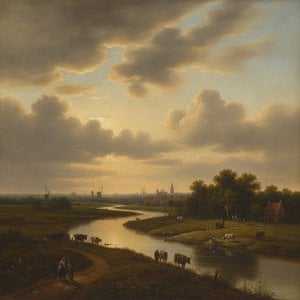
Discover the breathtaking beauty of Dutch Golden Age landscapes. Explore the mastery of light, chiaroscuro, and 17th-century realism through an expert art history lens, celebrating the enduring legacy of the Dutch Masters for discerning collectors and art lovers.

Embark on a cultural journey through the Dutch Golden Age. Explore the masterful interplay of light and shadow in 17th-century masterpieces, from Rembrandt to Vermeer, and discover how this era of profound realism continues to inspire fine art collectors today.

Explore the Dutch Golden Age of painting! Discover key artists like Vermeer & ter Borch, their innovative techniques, and the rich cultural context behind these Baroque masterpieces. Learn about collecting & appreciating this iconic art period.
Explore the Dutch Golden Age of painting (1600-1700) with WahooArt. Discover Rembrandt, Vermeer & other masters. Learn about techniques, history & find museum-quality reproductions.

Journey through the Golden Age with our guide to the Top 10 Dutch Baroque masterpieces! Explore iconic paintings by Rembrandt, Vermeer & Frans Hals. Find museum-quality art reproductions and elevate your home decor at WahooArt.com.

 실제 크기로 보기
 보내기
보내기 공유하기
공유하기
 상세 보기
상세 보기 가이드 보기

 이미지 다운로드
 유사 작품 더 보기
 X-레이
X-레이 슬라이드 쇼 보기
 통계 정보
통계 정보 상세 보기
상세 보기









 유리 옵션은 110cm 미만 크기에서만 선택 가능합니다.


