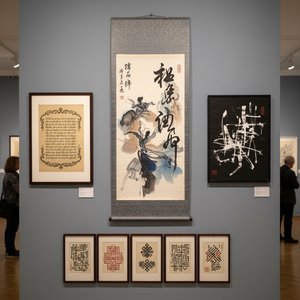
Qian Mu: Echoes of Tradition in Contemporary Calligraphy
Qian Mu (錢穆), born in Shandong Province, China, stands as a towering figure in the realm of Chinese calligraphy and scholarship—a testament to unwavering dedication to preserving and reimagining the heritage of his nation. While biographical details remain somewhat sparse due to his preference for privacy, his impact on modern Chinese intellectual discourse is undeniable. His formative years were steeped in Confucian ideals instilled by his father, a respected educator who championed moral philosophy and filial piety. This upbringing profoundly shaped Mu’s worldview and fueled his lifelong pursuit of understanding the essence of Chinese culture. He excelled academically at Tsinghua University, earning degrees in mathematics and physics before pivoting towards humanities studies—a decision that would ultimately define his artistic trajectory. Mu's calligraphy journey began modestly, initially exploring Xing Shu (行書), a cursive style characterized by its flowing brushstrokes and expressive rhythm. However, he quickly mastered Kaishu (楷書), the standard script revered for its precision and clarity—a stylistic choice reflecting his intellectual temperament and commitment to upholding Confucian principles of rationality and order. Unlike many contemporary artists who prioritize innovation above all else, Mu consistently sought to honor tradition while subtly infusing it with personal vision. His artistic development wasn't solely driven by technical mastery; it was deeply intertwined with his engagement with classical Chinese poetry and literature. He meticulously studied the works of Tang Dynasty poets like Li Bai and Du Fu, absorbing their stylistic nuances and philosophical insights—influences that permeated his own calligraphy. Mu’s pieces often depict serene landscapes imbued with symbolic references to Confucian virtues—a deliberate effort to communicate profound ideas through visual artistry. Throughout his prolific career spanning decades, Qian Mu produced an impressive body of work encompassing numerous Xing Shu and Kaishu scrolls and prints. His calligraphy gained recognition for its exceptional beauty and intellectual depth—demonstrating a remarkable ability to synthesize tradition with innovation. Notably, he served as President of Tsinghua University during a pivotal period in China’s reform era, guiding the institution through significant transformations while upholding its commitment to academic excellence. Mu's legacy extends far beyond his artistic accomplishments; he remains a celebrated scholar and educator whose writings continue to inspire generations of Chinese intellectuals. His magnum opus, “The Confucian Canon,” meticulously reconstructed and analyzed the foundational texts of Confucian philosophy—establishing him as one of China’s foremost thinkers on ethics and governance. Qian Mu’s unwavering devotion to preserving cultural heritage and fostering intellectual curiosity cemented his place in history as a beacon of wisdom and integrity—a figure whose calligraphy serves as enduring symbol of Chinese artistic tradition.- Notable Achievements: Tsinghua University Presidency, Extensive Publication Record
- Influences: Confucian Philosophy, Tang Dynasty Poetry
- Style Characteristics: Xing Shu & Kaishu Mastery, Landscape Imagery with Symbolic References