Adolphe Pierre Leleux: The Breton’s Painter
Adolphe Pierre Leleux (1812-1891) remains a captivating figure in 19th-century French art, largely due to his evocative depictions of Brittany and Algeria. Born in the heart of Paris, Leleux's artistic journey was remarkably independent; he eschewed formal training, choosing instead to cultivate his skills through observation and direct experience. This self-taught approach profoundly shaped his distinctive style – a blend of realism, romanticism, and a deep connection to the landscapes and people he encountered. His legacy isn’t one of grand historical narratives or revolutionary techniques, but rather in the quiet beauty and authentic portrayals of everyday life within specific regional contexts.
Early Life and Artistic Beginnings
Leleux's early years were marked by a fascination with illustration and engraving, initially studying under Alexandre Vincent Sixdeniers. However, it was his discovery of Brittany in 1838 that proved to be the catalyst for his artistic development. Drawn to the rugged coastline, vibrant villages, and distinctive culture of this region, Leleux began to capture its essence on canvas. This immersion wasn’t merely a fleeting excursion; he spent considerable time living amongst the Breton people, meticulously studying their customs, dress, and interactions with the natural world. This intimate knowledge is immediately apparent in his paintings – they possess an unparalleled sense of place and authenticity. The nickname “Leleux le Breton” arose organically from this deep connection, signifying his status as a true observer and interpreter of Breton life.
Breton Landscapes and Genre Scenes
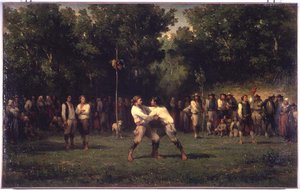
Leleux’s most celebrated works are undoubtedly those depicting the Breton countryside. Paintings like "Une noce en Bretagne" (1863), housed in the Quimper Musée des Beaux-Arts, offer a glimpse into traditional Breton weddings – the vibrant costumes, lively music, and communal spirit are rendered with remarkable detail and warmth. Similarly, “Jour de fête en Cornouaille” (1864) captures the energy of a rural festival, showcasing the region’s distinctive traditions and social fabric. These scenes aren't simply picturesque; they are imbued with a sense of lived experience, reflecting Leleux’s genuine appreciation for Breton culture. He frequently depicted scenes of daily life – fishermen hauling their nets, farmers tending to their fields, and villagers engaged in various activities—all rendered with a keen eye for detail and an understated elegance.
Algerian Influences and Exoticism
Beyond Brittany, Leleux spent several years in Algeria, where he encountered a dramatically different landscape and culture. This experience profoundly impacted his artistic sensibilities, leading him to paint scenes of Bedouin life ("Bedouins attaques par des chiefs," 1850) and depictions of Algerian farmers (“Bucherons Bretons,” 1845). These works demonstrate a shift in subject matter, moving away from the familiar Breton countryside towards more exotic locales. While some critics have interpreted these paintings as representing a romanticized view of the “Orient,” Leleux’s approach was characterized by careful observation and respect for the people he depicted. His Algerian scenes are notable for their use of light and color, creating a sense of warmth and vibrancy that contrasts sharply with the cooler tones often associated with Breton landscapes.
Technique and Legacy
Leleux’s technique is characterized by a meticulous attention to detail and a skillful handling of paint. He employed a relatively small palette, favoring earthy tones and muted colors—a deliberate choice that enhanced the realism of his scenes. His brushwork is generally smooth and understated, allowing the details of his subjects to speak for themselves. While he participated in the Paris Salon from 1835 onwards, Leleux never achieved widespread fame during his lifetime. However, his work has since been recognized as a significant contribution to French genre painting, particularly for its authentic portrayal of Breton culture. His legacy lies not in grand pronouncements or revolutionary innovations, but rather in the quiet beauty and enduring charm of his paintings—a testament to the power of observation, dedication, and a genuine connection to the world around him. His work continues to be exhibited and studied, offering viewers a unique window into 19th-century France and the captivating landscapes of Brittany and Algeria.