The Master of Opulence: The Life and Legacy of Meiffren Conte
In the grand, sun-drenched tapestry of the seventeenth century, a period defined by both the intellectual dawn of the Enlightenment and the dramatic flourishes of the Baroque, few artists captured the tactile splendor of material wealth as exquisitely as Meiffren Conte. Born around 1630 into an established family in the vibrant port city of Marseille, Conte emerged not merely as a painter, but as a visual chronicler of luxury. His life was a journey through the most influential artistic hubs of Europe, moving from the Mediterranean warmth of his birthplace to the classical grandeur of Rome, and eventually to the royal splendor of Paris. While the archives of history occasionally shroud the intimate details of his early years in shadow, his brushwork remains an indelible light, illuminating a world of silver, gold, and rare treasures that might otherwise have been lost to time.
Conte’s artistic soul was forged in the crucible of classical training and international pilgrimage. After establishing his foundational skills under the guidance of Rodolphe Ziegler, a respected figure in Marseille, the young artist sought the ultimate inspiration found only in the Eternal City. His arrival in Rome around 1656 marked a pivotal transformation in his aesthetic vision. It was here that he encountered the profound influence of Francesco Noletti, whose mastery of dramatic chiarosc Century and expressive dynamism left an indelible mark on Conte’s technique. This Roman sojourn infused his work with a sense of theatricality, teaching him how to manipulate light and shadow to breathe life into inanimate objects, turning cold metal and fragile shells into protagonists of a silent, opulent drama.
A Symphony of Texture and Light
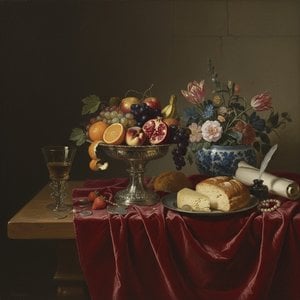
To gaze upon a Meiffren Conte masterpiece is to undergo a sensory experience that transcends the flat surface of canvas. He possessed an almost supernatural ability to render the varying textures of the physical world—the cold, reflective sheen of polished silver; the heavy, lustrous weight of gold plate; and the delicate, calcified ridges of exotic nautilus shells. His compositions were often meticulously arranged, featuring a collection of rare or expensive objects that served as much more than mere decoration. In an era where many such precious metalworks were eventually melted down due to the economic pressures of war under Louis XIV or the political upheavals of the French Revolution, Conte’s paintings serve as vital, irreplaceable historical records of a vanished material culture.
His technical prowess was characterized by what connoisseurs described as great veracity. He did not merely paint objects; he captured their very essence through an astute understanding of how light interacts with different surfaces. Whether it was the glint of a sword’s edge or the soft, organic curves of a seashell, Conte utilized the Baroque tradition of dramatic contrast to guide the viewer's eye through his intricate arrangements. This mastery allowed him to elevate the still life genre from simple observation to a profound exploration of beauty, permanence, and the fleeting nature of earthly riches.
Parisian Splendor and Final Reflections
The trajectory of Conte’s career reached new heights when he relocated to Paris in 1671. In the heart of the French capital, he became part of the prestigious artistic circle associated with the Gobelins manufactory, the royal workshop tasked with creating the lavish furnishings and tapestries that defined the reign of the Sun King. This association placed him at the very epicenter of European patronage, allowing his work to reach the most discerning collectors and royalty of the age. His time in Paris, alongside his periods in Aix-en-Provence, solidified his reputation as a premier painter of the French Baroque, capable of satisfying the era's hunger for grandeur and meticulous detail.
As his life drew to a close, Conte eventually returned to his roots, passing away in Marseille in 1705. He left behind a legacy that continues to resonate within the halls of great museums, such as The Metropolitan Museum of Art, where his works remain celebrated for their breathtaking precision. His contribution to art history lies not only in his technical brilliance but in his role as an artist who captured the ephemeral beauty of the material world, preserving the shimmering ghosts of a golden age for all eternity.