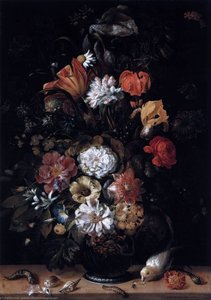
Johann Adalbert Angermayer: A Bohemian Still Life Pioneer
Johann Adalbert Angermayer (Czech: Jan Vojtěch Angermayer, 1674–1742) stands as a pivotal figure in the history of Czech Baroque painting, particularly renowned for his meticulous cabinet still life compositions that captured the delicate beauty of natural objects with unparalleled precision. Born in Bílina, Bohemia – then part of Habsburg Austria – Angermayer’s artistic journey unfolded against the backdrop of Prague’s burgeoning cultural landscape and cemented his place as one of the era's foremost practitioners of this genre.Early Life and Artistic Training
Angermayer’s formative years were spent in Bílina, where he received a grounding in humanist education – a hallmark of Bohemian intellectual life at the time. However, it was his relocation to Prague in 1699 that truly propelled him toward artistic excellence. Recognizing Angermayer's talent, Johann Rudolf Byss, a celebrated Leiden Fijnschilder (Dutch painter), took him on as a pupil, introducing him to the stylistic innovations of Dutch Baroque art – specifically the meticulous observation and detailed rendering championed by artists like Johannes Vermeer and Pieter Claesz. This mentorship proved invaluable, shaping Angermayer’s artistic sensibilities and establishing him firmly within the influential Prague Painter's Guild.Prague Painter’s Guild Membership and Artistic Development
Joining the Old Town Painter’s Guild in 1707 marked a significant milestone in Angermayer’s career, affording him access to professional networks and fostering collaboration with fellow artists. During his guild membership (1707-1727), he honed his skills further, experimenting with innovative techniques and exploring diverse subjects—primarily still lifes that showcased exquisite detail and subtle tonal variations. His compositions often featured meticulously arranged flowers, fabrics, hunting trophies, or occasionally symbolic objects like watches or jewelry boxes – reflecting the prevailing aesthetic sensibilities of Prague’s artistic circles. Notably influenced by Byss's Dutch training, Angermayer embraced a style characterized by realism and careful attention to texture and illumination, mirroring the stylistic trends prevalent in Leiden at the time.Notable Works and Legacy
Angermayer’s oeuvre comprises approximately 60 paintings, predominantly cabinet still lifes that exemplify the Baroque ideal of capturing fleeting beauty with unwavering accuracy. Among his most celebrated pieces are “Still Life with a Watch” (1708) and “Still Life with a Jewelry Box,” which demonstrate Angermayer's mastery of chiaroscuro—the dramatic interplay of light and shadow—a technique perfected by Rembrandt and Caravaggio. His paintings possess an understated elegance, conveying a profound appreciation for the natural world and reflecting the humanist values that underpinned Bohemian intellectual culture during his lifetime. Angermayer’s influence extended beyond his own artistic output; he served as a teacher to younger artists like John Caspar Hirschely and Carl Kastner, ensuring the continuation of his stylistic legacy within Prague's artistic community. His meticulous approach to painting—characterized by painstaking observation and masterful execution—established him as a cornerstone of Bohemian Baroque art history. Today, Angermayer’s works reside in museums across Europe, offering enduring testament to his contribution to the visual arts and preserving a captivating glimpse into the aesthetic tastes of 18th-century Bohemia.- Stiftskirche St. Johann (Regensburg)
- RKD Research
- Angermayer, Jan Vojtech - Paintings Before 1800
- Johann Adalbert Angermayer