Johannes Koulix: A Master of Byzantine Manuscript Illumination
The world of medieval art offers glimpses into a rich tapestry of faith, culture, and artistic skill, and among its most captivating figures stands Johannes Koulix. Born in 1101, Koulix’s legacy resides primarily within the delicate beauty of his illuminated manuscript leaf from the Epistle to the Hebrews—a testament to the enduring power of Byzantine artistry. While details surrounding his life remain somewhat sparse, his work speaks volumes about the artistic conventions and spiritual fervor of his era.
Koulix’s artistic journey began within the vibrant context of 12th-century Byzantium, a period marked by both political instability and unparalleled cultural flourishing. The Byzantine Empire, though diminished in size, retained a profound influence on art across Europe, particularly in its religious iconography. Koulix's work is deeply rooted in this tradition, drawing heavily from the established styles of illuminated manuscripts produced in Constantinople’s imperial workshops. These workshops were renowned for their meticulous attention to detail, vibrant colors, and sophisticated understanding of perspective—elements that are strikingly evident in his ‘Epistle to the Hebrews.’
The 'Epistle to the Hebrews': A Window into Medieval Art
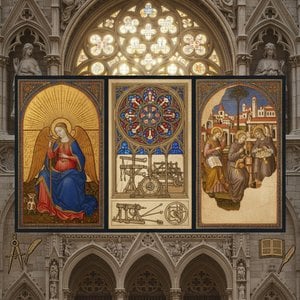
The ‘Epistle to the Hebrews’ leaf itself is a remarkable achievement. Executed primarily in tempera, gold leaf, and ink on parchment, it exemplifies the techniques of Byzantine manuscript illumination. The tempera pigments—derived from minerals and plants—were carefully layered to achieve astonishing depth and luminosity. The application of gold leaf, a hallmark of Byzantine art, wasn’t merely decorative; it symbolized divine light and holiness, elevating the text and drawing the viewer's eye to the sacred words. The intricate script, likely penned by a skilled calligrapher, is rendered with exceptional clarity and precision, demonstrating a mastery of the alphabet and a deep respect for the written word.
Beyond the technical skill, the leaf’s imagery is imbued with symbolic meaning. The figures depicted—likely representing biblical characters or theological concepts—are rendered in a stylized manner characteristic of Byzantine art. The use of flattened perspective and elongated proportions creates a sense of timelessness and spiritual elevation. The overall composition is carefully balanced, reflecting the harmony and order valued within the Christian faith.
Technique and Materials: A Labor of Love
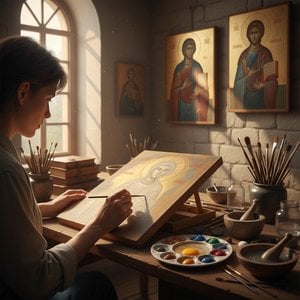
Creating such a masterpiece demanded immense patience and skill. Parchment, made from animal skin, was prepared meticulously before receiving the artist’s hand. The tempera paint had to be applied in thin layers, allowing each layer to dry completely before adding the next. Gold leaf, painstakingly hammered into incredibly thin sheets, was then carefully adhered to the surface using a special adhesive. The entire process would have taken considerable time—months, perhaps even years—reflecting the value placed on these illuminated manuscripts as objects of devotion and learning.
Koulix’s mastery extends beyond simply replicating established styles; he demonstrates an understanding of how to imbue his work with a sense of movement and dynamism. The drapery of the figures flows gracefully, while the details—such as the folds in robes or the texture of fabrics—are rendered with remarkable realism. This attention to detail is further enhanced by the use of subtle shading and highlights, creating a three-dimensional effect that brings the scene to life.
Historical Significance and Legacy
Johannes Koulix’s ‘Epistle to the Hebrews’ leaf stands as a poignant reminder of the artistic achievements of the Byzantine era. It is not merely a beautiful object but also a valuable historical document, offering insights into the religious beliefs, artistic conventions, and technological skills of 12th-century Byzantium. While Koulix's life remains largely undocumented, his work continues to captivate viewers with its exquisite beauty and profound spiritual resonance. His dedication to his craft ensured that his contribution to the world of illuminated manuscripts would endure for centuries to come, a testament to the lasting power of human creativity.