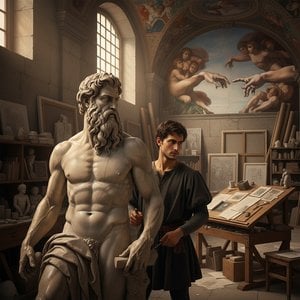
The Sculptor of Spiritual Resonance: The Life of Jerónimo Hernández Estrada
In the golden twilight of the Spanish Renaissance, a period defined by profound religious fervor and the blossoming of humanist ideals, the name Jerónimo Hernández Estrada emerges as a whisper of quiet revolution. Born around 1540 in the rugged, storied streets of Ávila, Spain, Hernández Estrada was destined to become a master of form and emotion. His early years were rooted in the humble traditions of craftsmanship; the son of Juan Hernández and Catalina Estrada, he grew up amidst the scent of cedar and the rhythmic sounds of carpentry. This foundational connection to the tactile nature of wood and material would later inform his ability to breathe life into stone and polychrome, transforming cold matter into vessels of divine grace.
The trajectory of his genius was set in 1553 when he entered the prestigious workshop of Juan Bautista Vázquez el Viejo. This apprenticeship was far more than a mere vocational training; it was an immersion into the very heart of the Spanish sculptural tradition. Under Vázquez’s tutelage, Hernández Estrada mastered the delicate balance between classical proportions and the expressive intensity required by the Counter-Reformation. By 1560, following the passing of his parents, he followed his master to the vibrant, cosmopolitan atmosphere of Seville. This move proved transformative, placing him at the epicenter of a burgeoning artistic movement where the architectural grandeur of the era met the intimate needs of religious devotion.
A Union of Art and Architecture
The development of Hernández Estrada’s career was significantly bolstered by his integration into the highest echelons of Seville's artistic elite. In 1567, his marriage to María de Guzmán y Aragón—the daughter of the legendary architect Hernán Ruiz II—created a powerful nexus of creative talent. This union was not merely social but profoundly professional, providing Hernández Estrada with the patronage and the structural context necessary to expand his artistic vision. Through this connection, his sculptures were no longer isolated objects of devotion but integral components of the grand architectural narratives being constructed in Seville’s cathedrals and chapels.
His work during this period reflects a sophisticated mastery of Romanismo, a style that sought to harmonize the classical elegance of the Italian Renaissance with the specific liturgical demands of the Spanish Church. His ability to navigate these complex stylistic currents allowed him to create works that were both intellectually stimulating and emotionally accessible. The influence of Ruiz II’s architectural precision likely guided Hernández Estrada's understanding of space, ensuring that his sculptures possessed a monumental presence even when rendered in smaller, more intimate scales.
Legacy in Stone and Spirit
The enduring significance of Jerónimo Hernández Estrada lies in his ability to capture the ephemeral nature of faith through the permanence of sculpture. While he may have lived in the shadow of giants like Vázquez, his individual contribution to the Spanish Renaissance is unmistakable. His repertoire included deeply moving subjects that invited contemplation and prayer, such as:
- Cristo recibiendo el cáliz del ángel: A profound exploration of divine communion located within the Montesión Chapel in Seville (1578).
- Niño de Jesús: A tender, masterful depiction of infancy and divinity, created for the parish of Santa María Magdalena (1581-1582).
Though his life was tragically short, ending in 1586, the impact of his hands remains etched in the history of Spanish art. He succeeded in a rare feat: he bridged the gap between the rigorous discipline of the workshop and the transcendent aspirations of the soul. Today, as scholars revisit his prolific output, Hernández Estrada is recognized not just as a skilled craftsman, but as a pivotal sculptor who helped define the visual language of devotion for generations to come.