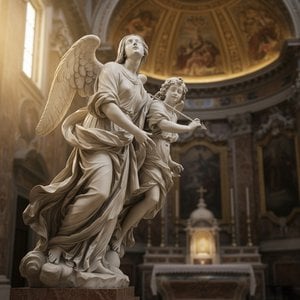
Georg Rafael Donner (1693–1741): Sculptor of Baroque Splendor and Antiquity’s Echoes
Georg Rafael Donner was a singular figure in the artistic landscape of 18th-century Austria—a sculptor whose oeuvre defied easy categorization, blending the opulent grandeur of baroque aesthetics with an unexpected fascination for classical ideals. Born in Esslingen am Neckar in 1693, Donner emerged from humble beginnings to become one of the most prolific sculptors of his era, leaving behind a legacy marked by monumental works and enduring stylistic innovation. His artistic journey was profoundly shaped by Vienna’s academy and the influence of antique sculpture, which captivated him with its harmonious proportions and timeless beauty—a fascination that would permeate throughout his entire oeuvre.
Early Life and Artistic Training
Donner's formative years were spent in Esslingen, where he received a foundational education in goldsmithing before pursuing formal sculptural training under Giovanni Giuliani, a Venetian sculptor who established himself in Vienna. This dual influence instilled in him a meticulous craftsmanship combined with an appreciation for artistic experimentation. Giuliani’s guidance honed Donner’s technical skills while simultaneously exposing him to the stylistic nuances of Venetian baroque—a style characterized by dramatic ornamentation and theatrical dynamism. Recognizing his talent, Giuliani encouraged Donner's exploration of diverse artistic mediums and techniques, preparing him for a distinguished career ahead.
The Baroque Vision: Salzburg and Beyond
Donner’s breakthrough came with his relocation to Salzburg in 1725, where he undertook the ambitious commission of creating monumental sculptures for Mirabel Castle—a project that cemented his reputation as a master sculptor. The Donnersteig, a breathtaking staircase adorned with intricate marble reliefs depicting mythological figures and allegorical scenes, exemplifies his masterful command of baroque sculptural technique. Simultaneously, he served Bishop Esterházy, crafting a gravestone imbued with solemn dignity and reflecting the stylistic conventions of the time. His work extended beyond Salzburg’s borders, encompassing commissions in Pozsony (Bratislava) where he sculpted St. Martin's equestrian monument—a testament to his ability to convey movement and grandeur—and Vienna, where he designed two fountains celebrating Austria’s rivers and a monumental sculpture commemorating Emperor Charles VI.
Vienna’s Artistic Patronage and Monumental Achievements
Vienna became Donner’s artistic home for nearly a decade, fostering collaborations with prominent patrons and propelling him to the forefront of Viennese baroque art. His involvement in the decoration of St. John's Church—a project that showcased his sculptural prowess alongside intricate frescoes—demonstrates his commitment to elevating architectural spaces through visual artistry. Furthermore, Donner’s contribution to the creation of monumental sculptures like “The Source” and “Perzei and Andromeda,” positioned before City Hall, solidified his place as a pivotal figure in Viennese artistic history. Notably, Donner's final masterpiece – the Pietà at Gurk Cathedral—stands as an enduring symbol of baroque piety and artistic excellence.
Legacy and Influence
Georg Rafael Donner’s impact on Austrian sculpture extends far beyond his individual creations. He mentored numerous German sculptors, shaping the stylistic trajectory of a generation and ensuring that his distinctive vision continued to inspire artists for years to come. His rediscovery as a central motif of the Austrian gold euro commemorative coin underscores his enduring cultural significance—a tangible reminder of his contribution to Austria’s artistic heritage. Donner's unwavering dedication to blending baroque exuberance with classical ideals remains an inspiration for contemporary sculptors, cementing his position as one of the most influential artists of the 18th century.