The Luminous Legacy of Charles Frechon
In the golden age of French landscape painting, few artists captured the ephemeral dance of light and atmosphere as intimately as Charles Frechon. Born in Paris in 1856, Frechon emerged during a transformative era when the rigid boundaries of academic tradition were beginning to dissolve under the influence of Impressionism. While his formal training at the prestigious École des Beaux-Arts provided him with a foundation of technical mastery, his heart belonged to the untamed beauty of the natural world. His journey was one of constant movement—from the structured streets of Paris to the rolling, verdant hills of Normandy and the sun-drenched expanses of the Loire Valley—seeking always that precise moment when light transforms a landscape into a living, breathing entity.
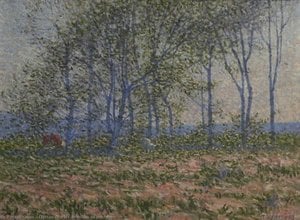
Frechon’s artistic evolution is a fascinating study of stylistic synthesis. In his early years, one can clearly discern the profound impact of masters like Monet and Pissarro. He adopted their revolutionary use of broken brushstrokes to replicate the flickering quality of sunlight, yet he never fully surrendered to the purely optical experiments of the Impressionists. Instead, Frechon infused his work with a subtle Symbolist sensibility, imbuing his landscapes with an emotional depth that transcended mere visual documentation. His paintings do not simply show us a field or a river; they invite us to feel the quiet solitude of a forest glade or the vibrant energy of a bustling Rouen street.
A Mastery of Light and Landscape
The true soul of Frechon’s oeuvre lies in his profound connection to the French countryside. He possessed an uncanny ability to render the specific textures of the Normandy landscape, from the heavy, dew-laden air of apple orchards to the shimmering, mercurial surfaces of meandering rivers. His fascination with water allowed him to explore the complexities of reflection and refraction, creating works where the sky and earth seem to merge in a seamless tapestry of color. This mastery is perhaps most evident in his depictions of the Loire Valley, which many scholars consider the zenith of his creative output.
Beyond the pastoral, Frechon also found inspiration in the rhythmic pulse of urban life. His paintings of Rouen serve as poignant windows into the late 19th-century French experience. In works such as “Boulevard Cauchoise,” he captures the movement and vitality of the city's squares, blending the architectural permanence of the streets with the fleeting shadows of passersby. This duality—the ability to move between the monumental and the momentary—is what defines his unique contribution to the era.
Artistic Achievements and Lasting Significance
The significance of Charles Frechon lies in his role as a bridge between eras. He took the light-centric innovations of the Impressionists and anchored them with a sense of structural permanence and emotional resonance that spoke to the changing sensibilities of the early 20th century. His work remains a testament to the enduring power of nature and the human ability to perceive beauty in its most transient forms. Today, his legacy is preserved through various collections and museums, where his canvases continue to inspire awe through their luminous palettes and evocative compositions.
To understand the breadth of his impact, one might reflect on the following themes present throughout his career:
- The Impressionist Influence: The use of broken brushwork and a focus on atmospheric effects.
- Regional Devotion: His deep, evocative portrayals of Normandy and the Loire Valley.
- Urban Observation: Capturing the everyday vitality of Rouen’s streets and squares.
- Emotional Depth: Moving beyond optical realism to achieve a subjective, poetic expression of nature.