A Visionary of Light and Landscape: The Life of DeLancey Walker Gill
In the tapestry of American art history, few figures possess the multifaceted brilliance of DeLancey Walker Gill. A man whose creative spirit refused to be confined by a single medium, Gill navigated the worlds of draughtsmanship, watercolor painting, and photography with a singular, meticulous grace. Born on July 1, 1859, in Camden, South Carolina, his early years were shadowed by the profound tragedy of the American Civil War, which claimed the life of his father when Gill was only five. This early encounter with loss perhaps forged the resilience that would later define his career, as he moved westward to Wyoming and eventually established himself as a vital chronicler of the American landscape and its diverse peoples.
Gill’s artistic journey was not one of mere academic pursuit but of disciplined self-discovery and professional rigor. His early training under the legendary Supervising Architect Louis Sullivan at the Capitol Building instilled in him a foundational precision—a gift for detail that would become the hallmark of his later works. This technical mastery, rooted in the architectural draftsmanship of the era, allowed him to approach the natural world with both an artist's eye for beauty and a scientist's eye for structural truth. Under the mentorship of the esteemed watercolorist William Henry Holmes, Gill refined his ability to capture the ephemeral nuances of light and texture, transforming landscapes into poetic meditations on the American wilderness.
The Intersection of Science and Artistry
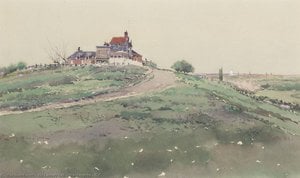
Perhaps the most significant chapter of Gill’s life was his long-standing association with the Smithsonian Institution's Bureau of American Ethnology. Serving as the director of the Division of Illustration from 1889 to 1932, he occupied a unique position where scientific documentation met fine art. His work during this period was far more than mere record-keeping; it was an evocative exploration of the American West. Through his watercolors and landscape illustrations, Gill brought the vibrant, sun-drenched vistas of Arizona, Wyoming, and the Pueblo landscapes to a wider audience, imbuing them with a sense of profound atmosphere and depth.
When the need for visual documentation grew, Gill seamlessly transitioned into photography, taking over duties at the Bureau in 1898. This period saw him producing thousands of photographs that captured the dignity of Native American delegations, including legendary figures such as Geronimo and Chief Joseph. While modern scholars occasionally critique the ethnographic practices of the era—noting how certain costuming choices may have reinforced contemporary stereotypes—there is no denying the immense historical value of his photographic legacy. His ability to blend the pictorialist aesthetic with documentary necessity allowed him to create portraits that possessed both a striking strength of design and an enduring, soulful quality.
A Lasting Legacy in the American Canon
Throughout his prolific life, Gill remained a dedicated educator and a tireless observer of the world around him. Whether he was capturing the quiet, working-class streets of Washington, D.C., or the rugged majesty of the Southwest, his work always reflected an acute sensitivity to the textures of life. His contributions were recognized far beyond the halls of the Smithsonian; his photographic work graced the Panama–Pacific Exposition and even earned a place on a 1923 United States postage stamp.
As he taught art classes at the Corcoran School, passing his meticulous techniques to a new generation, Gill continued to refine his mastery of the landscape. He left behind a body of work that serves as a vital bridge between the scientific observation of the late 19th century and the expressive freedom of early 20th-century pictorialism. Today, we remember DeLancey Walker Gill not just as a photographer or a painter, but as a pioneer who used every tool at his disposal to illuminate the complex, beautiful, and often overlooked corners of the American experience.