Basilio Cascella: Life and Legacy
Early Life and Education
Basilio Cascella was born on October 1, 1860, in Pescara, Italy, to Francesco Paolo Cascella and Marianna Siciliano. His early life saw a family move to Ortona in 1870 where he completed his elementary education. Demonstrating artistic inclination from a young age, he attended the Artieri night school in Pescara and began an apprenticeship at the Luigi Salomone printing plant in 1874, copying prints and developing foundational skills. Despite his father’s desire for him to join the family tailoring business, Cascella pursued his passion for art.
Artistic Development and Influences
In April 1875, Cascella moved to Rome, securing an apprenticeship in lithography at Luigi Salomone’s printing plant. He later settled in Naples in 1879, immersing himself in the artistic community and connecting with artists like Domenico Morelli and Francesco Paolo Michetti. This period marked his embrace of the Verismo style, characterized by realism and depictions of everyday life. His work was influenced by a diverse range of movements including the Italian Renaissance, Late Gothic art, and Neoclassicism.
Career and Exhibitions
Cascella’s career spanned from the late nineteenth to the mid-twentieth century. He worked across painting, graphic design, and illustration, even establishing a lithographic illustration factory in Milan. His work gained recognition through exhibitions at prestigious venues such as the National Artistic Exhibition of Turin (1884) and the Art Exhibition of Venice (1887), alongside notable artists like Giovanni Segantini and John Singer Sargent. He also exhibited in London (1888) and Palermo (1891).
Family Legacy and Collaborative Work
Cascella’s artistic influence extended to his family; three of his sons – Tommaso Cascella, Michele Cascella, and Gioacchino Cascella – also became accomplished artists. He fostered a vibrant creative environment, becoming part of the Convento Michetti alongside figures like Gabriele D'Annunzio. In 1899, he founded the magazine “L’Illustrazione Abruzzo,” providing a platform for local writers and artists. Later publications included “L’illustrazione meridionale” and “La Grande Illustrazione”, featuring contributions from prominent Italian literary figures.
Major Achievements and Artistic Contributions
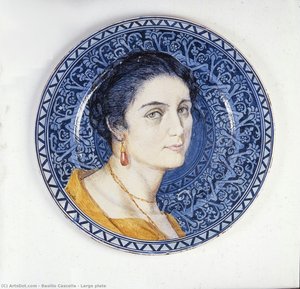
- Ceramic Panels: In the 1920s, Cascella transitioned to ceramics, creating notable panels for locations like the tomb of Andrea Bafile, the Terme del Tettuccio in Montecatini, and the Milano Centrale railway station.
- Decorative Commissions: He completed significant decorative commissions, including panels for the Messina maritime station designed by his son Michele.
- Political Involvement: In 1929, Cascella was elected as a deputy to the Italian Parliament, serving until 1934.
Historical Significance and Lasting Impact
Basilio Cascella’s work provides valuable insight into Italian society and artistic trends during a period of significant change. His commitment to Verismo captured the essence of everyday life, while his diverse range of artistic endeavors demonstrated his versatility and dedication. He remains a notable figure in Italian art history, with his works displayed at institutions like the Museo Nazionale di Capodimonte in Naples and celebrated through the Basilio Cascella Civic Museum in Pescara. His legacy continues to inspire artists and scholars alike.