Anthonie Constantijn Govaerts: A Window into 19th-Century Belgian Life
Born in Antwerp in 1806, Anthonie Constantijn Govaerts was a painter who dedicated his artistic life to capturing the everyday realities of 19th-century Belgium. While he may not be as widely celebrated as some of his contemporaries, Govaerts’s work offers a remarkably intimate and authentic glimpse into peasant life, bustling market scenes, and the quiet domesticity of rural interiors – subjects that resonated deeply with audiences seeking a connection to their own roots.
Govaerts's artistic journey began in Antwerp, a city steeped in artistic tradition. The burgeoning atmosphere of the early 19th century, marked by Romanticism’s emphasis on emotion and the sublime, undoubtedly influenced his initial explorations. However, Govaerts quickly developed a distinct style, firmly rooted in Realism. He eschewed grand historical narratives or idealized portraits, instead focusing on the lives of ordinary people – farmers, market vendors, women tending to their homes – with an unwavering commitment to portraying them truthfully and without embellishment.
Genre Scenes and the Language of Everyday Life
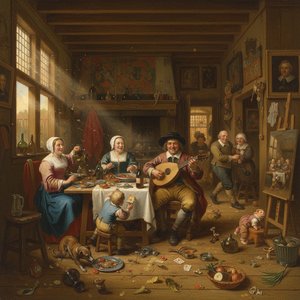
Govaerts is primarily known for his genre paintings. These scenes aren’t dramatic or heroic; they are snapshots of daily existence. His most celebrated works, such as “Een marketenster in het leger” (A Market Woman in the Army) and “Een binnenhuis met boeren en boerinnen om koek dobbelende” (An Interior with Peasants and Peasant Women Playing Dice), offer a compelling visual narrative of rural Belgian society. The details are meticulously rendered: the worn clothing, the weathered faces, the simple tools – all contribute to a powerful sense of authenticity.
The choice of subject matter itself is significant. Govaerts deliberately chose to depict those often overlooked by mainstream art—the working class and rural communities. This reflects a growing social consciousness in Belgium during his time, as artists began to question the established hierarchies and explore the lives of ordinary people. His paintings weren’t simply depictions; they were social commentaries, subtly highlighting the dignity and resilience of these individuals.
Technique and Artistic Style
Govaerts's technique is characterized by a remarkable attention to detail and a masterful use of light and shadow. He employed a muted palette—earthy browns, greens, and greys—to create a sense of realism and atmosphere. His brushwork is often loose and expressive, conveying the textures of fabric, wood, and skin with subtle yet effective strokes. He was particularly adept at capturing the nuances of human expression – the weariness in a peasant’s eyes, the quiet joy of a shared moment between family members.
While influenced by Dutch Realism, notably artists like Jacob van Sandt, Govaerts developed his own unique voice. His compositions are often asymmetrical and dynamic, drawing the viewer's eye through the scene with carefully placed figures and objects. His work demonstrates a keen observational skill, combined with a deep understanding of human psychology.
Notable Works and Legacy
Among Govaerts’s most recognized paintings is “The Camp Follower” (1825-1827), a poignant depiction of a woman accompanying an army unit. This work exemplifies his ability to imbue ordinary subjects with profound emotional depth. His market scenes, such as "Een marketenster in het leger," are equally compelling, offering a vivid portrayal of the energy and commerce of rural markets.
Sadly, Govaerts’s career was cut short by illness; he died in Brussels in 1855 at the age of 49. Despite his relatively brief career, Anthonie Constantijn Govaerts left behind a valuable body of work that provides a unique and enduring window into 19th-century Belgian life. His paintings continue to resonate with viewers today, reminding us of the beauty and dignity found in the everyday experiences of ordinary people.
Further Exploration
Discover more about Anthonie Constantijn Govaerts on WahooArt.com