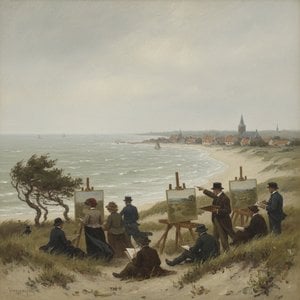
Eilert Adelsteen Normann: A Life Dedicated to Norwegian Landscapes
- Born: Bode, Norway (1848)
- Died: Kristiania (Oslo), Norway (1918)
Eilert Adelsteen Normann, later known simply as Adelsteen Normann, was a Norwegian painter celebrated for his evocative depictions of the Norwegian landscape, particularly its dramatic fjords. Born in 1848 in Bode, Norway, he would spend much of his career based in Berlin, Germany, while consistently returning to his native land for inspiration and artistic rejuvenation.
Early Life and Artistic Training
Normann's path to becoming a painter wasn’t immediate. Initially pursuing a career in commerce, he later dedicated himself to art. From 1869 to 1872, he studied at the Kunstakademie Düsseldorf, a prestigious institution known for its influential “Düsseldorf School” of painting. This training significantly shaped his artistic style and approach. He also studied under the Estonian painter Eugen Dücker, further honing his skills.
Artistic Style and Subject Matter
- Landscapes: Normann’s paintings were almost exclusively landscapes, invariably featuring the fjords of Norway.
- Key Elements: His compositions typically included water reflecting the sky, small houses and boats nestled along the shoreline, and steep, imposing mountainsides.
- Pointillist Technique: He developed a distinctive pointillist technique, using small dots of color to create luminous effects and capture the nuances of light on water and rock.
His work is often associated with Realism, Impressionism, and Post-Impressionism, reflecting his engagement with contemporary artistic trends.
Influence and Legacy
- Edvard Munch: Normann played a pivotal role in the career of Edvard Munch. Recognizing Munch's talent while exhibiting in Kristiania (Oslo), Normann invited him to Berlin in 1892. This invitation proved crucial, leading to a groundbreaking exhibition that caused a sensation and ultimately contributed to the formation of the Berlin Secession movement.
- Popularizing Norwegian Fjords: Normann’s paintings are widely credited with significantly increasing the popularity of the Norwegian fjords as a tourist destination. His romanticized depictions captured the beauty and grandeur of these landscapes, inspiring travelers from across Europe.
- Exhibitions: Normann exhibited his work extensively throughout Europe, including in Oslo, Berlin, London, Vienna, Düsseldorf, Munich, and Paris. He received recognition at prestigious events like the Salon de Paris, earning a "mention honorable" in 1884 and a bronze medal in 1889.
- Dragon Style House: In 1891, he purchased and built a distinctive “dragon style” house near Balestrand, Norway – a pre-fabricated structure from Trondheim that became a testament to his connection with his homeland.
Later Years and Death
Despite residing in Germany from 1883 onwards, Normann consistently returned to Norway each summer. He died on December 26, 1918, in Kristiania (now Oslo), during the global Spanish flu pandemic. Today, his paintings are held in galleries across the globe, including Bergen, Cincinnati, Cologne, Dresden, Leeds, Liverpool, and Stockholm. A dedicated gallery showcasing thirty of his works stands in his birthplace, Bodin, Norway.