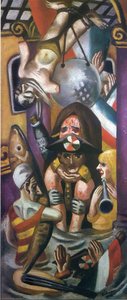
what is figurative expressionism?
Figurative Expressionism is a style that uses recognizable forms, such as the human body, to convey intense psychological and emotional states. It employs radical distortion, fragmented figures, and non-naturalistic colors to mirror inner turmoil, anxiety, or desire rather than providing an objective or photographic depiction of reality.
In the workshop, we recognize this movement by its physical presence on the canvas. It is not about smooth, invisible transitions but about a visible, often violent handling of materials. You will see heavy impasto, thick layers of paint, and gestural brushwork that leaves the artist's movements imprinted on the surface. The palette often relies on clashing or jarring hues to bypass the intellect and strike the viewer emotionally.
The movement manifests through several distinct regional developments:
- Boston Expressionism: Emerging in the 1930s, this style featured emotional directness and technical expertise, often influenced by the Jewish immigrant experience.
- Bay Area Figurative Movement: A mid-20th-century American movement from the 1950s and 1960s that utilized the spontaneous energy of abstraction to revisit the figure.
- New York Figurative Expressionism: A later development involving artists like Grace Hartigan and Alex Katz.
how does this style differ from realism and abstract expressionism?
 David Park
Explore David Park’s evocative Bay Area Figurative paintings! Capturing urban life & nudes with bold colors & textured forms. A pioneer of American art.
Figurative Expressionism sits between two poles: it rejects the objective accuracy of Realism while refusing to abandon the recognizable subject matter found in pure Abstraction. It maintains a tether to the human form, using it as a vessel for emotion rather than discarding it entirely.
When we compare these approaches at the bench, the technical differences are clear:
- Against Realism: While Realism seeks to replicate the physical world and anatomical accuracy, Figurative Expressionism deliberately distorts, elongates, or skews perspective to achieve a subjective truth.
- Against Abstract Expressionism: While it adopts the "action" and spontaneous, wet-on-wet brushstrokes of the New York School, it does not move into total non-objectivity; it retains identifiable objects and people.
This hybridity allows for a unique tension. For instance, in the Bay Area movement, artists like David Park moved away from pure abstraction to embrace a lush, painterly style that included drips and spatters, yet kept the subject grounded in recognizable scenes, such as his work Kids on Bikes.
who are the most important artists of the movement?
 The Scream
The Scream, Edvard Munch
Key figures include Edvard Munch, a pioneer whose works like The Scream (1893) established the foundation for emotional distortion, and Max Beckmann, known for symbolic compositions. Other vital contributors include Oskar Kokoschka, Ernst Ludwig Kirchner, and David Park, each using the figure to explore psychological depth.
The movement's lineage is built on several foundational painters:
The European Pioneers:
- Edvard Munch: His 1881 Self-Portrait demonstrates how a subjective perspective can distort reality for emotional effect.
- Ernst Ludwig Kirchner: A founder of Die Brücke, his work like Street, Dresden captures urban anxiety.
- Oskar Kokoschka: A psychologically penetrating portraitist whose work reflected the tensions of early 20th-century Vienna.
- Max Beckmann: Notable for works such as Man and Woman (1932).
The American Movements:
- David Park: The initiator of the Bay Area movement, whose technique evolved into heavy, wet-on-wet brushwork.
- Hyman Bloom and Jack Levine: Central figures of Boston Expressionism, known for their technical virtuosity and social themes.
- Karl Zerbe: A Boston artist who revived the ancient Egyptian medium of encaustic (pigment and hot wax) in the 1940s.
Frequently asked questions
When was Oskar Kokoschka born?
Oskar Kokoschka was born in Pöchlarn, Austria, on March 1, 1886.
When did the Bay Area Figurative Movement emerge?
The Bay Area Figurative Movement emerged during the 1950s and 1960s.
Who revived the encaustic medium?
Karl Zerbe revived the ancient Egyptian medium of encaustic in the 1940s.
When was the Contemporary Bay Area Figurative Painting exhibition held?
The exhibition Contemporary Bay Area Figurative Painting ran from September 8 to 29, 1957.
Learn more
- 1880 – 1938Ernst Ludwig KirchnerDiscover the bold, emotive urban landscapes and powerful figures of this Die Brücke pioneer.
- 1886 – 1980Oskar KokoschkaExplore the intense, psychological depth and expressive portraits of this Austrian Expressionist master.
- 1884 – 1950Max BeckmannExamine the haunting, symbolic compositions and distorted figures reflecting early 20th-century existential themes.