The Genesis of a Luminist: Kensett’s Early Life and Artistic Training
 Wikipedia: John Frederick Kensett
John Frederick Kensett (March 22, 1816 – December 14, 1872) was an American landscape painter and engraver born in Cheshire, Connecticut. He was a member of the second generation of the Hudson River School of artists. Kensett's signature works are la...
John Frederick Kensett, a name synonymous with the tranquil beauty of 19th-century American landscape painting, began his artistic journey not amidst sweeping vistas but within the precise confines of an engraver's workshop. Born in Cheshire, Connecticut, in 1816, young Kensett’s initial training under his father, Thomas Kensett, instilled a meticulous attention to detail that would later become a hallmark of his style. This early apprenticeship wasn’t merely technical; it fostered a deep understanding of line, form, and the subtle interplay of light and shadow – skills foundational for any aspiring artist, yet particularly crucial for one destined to capture the ethereal qualities of nature. His brief period with Peter Maverick in New York further refined these abilities, introducing him to a wider artistic circle and sparking an ambition that extended beyond the realm of reproduction. However, it was the untimely death of his father in 1829 that truly set Kensett on his path, forcing him to navigate the art world independently and ultimately leading him toward his true calling: painting.
The influence of artists like Asher B. Durand, whom he met early in his career, proved pivotal. Durand’s emphasis on direct observation from nature resonated with Kensett, steering him away from purely academic approaches towards a more personal and evocative representation of the American landscape. This period wasn't without its challenges; Kensett’s initial attempts at painting were often overshadowed by his engraving work, yet he persevered, driven by an innate desire to translate the beauty he perceived onto canvas.
From Engraving to Essence: The Evolution of Kensett's Style
Kensett’s artistic evolution was marked by a deliberate shift from the intricate detail demanded by engraving to a more suggestive and atmospheric approach. His formative years in Europe, spanning England, France, and Italy between 1840 and 1847, were instrumental in this transformation. While initially drawn to the Old Masters, Kensett gradually developed a unique sensibility, rejecting dramatic compositions in favor of quieter, more contemplative scenes. He absorbed the lessons of European landscape traditions but filtered them through his own American lens, seeking to capture not merely the *appearance* of nature but its very *essence*. This period saw him honing his skills en plein air, directly observing and sketching the landscapes that would later form the basis of his most celebrated works.
Upon his return to America in 1847, Kensett’s style began to coalesce. He became increasingly associated with the Hudson River School, though he distinguished himself from many of his contemporaries through a preference for cooler colors and a restrained palette. He wasn't interested in grandiose narratives or dramatic displays of power; instead, he sought to convey a sense of serenity and harmony, focusing on subtle shifts in light and atmosphere. This marked the beginning of his journey towards Luminism – a style characterized by its meticulous rendering of natural light and its emphasis on atmospheric perspective.
Capturing the American Sublime: Key Landscapes and Their Significance
 The Still Pool
Experience 'The Still Pool' by John Frederick Kensett – a luminous Hudson River School masterpiece capturing American nature’s serene beauty. Hand-painted reproductions available.
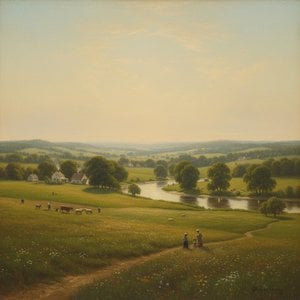
Kensett’s mature works are testaments to his mastery of capturing the American sublime. Paintings like “Shrewsbury River” (1856) exemplify his ability to transform a seemingly ordinary landscape into a scene of profound beauty and tranquility. The painting, a gift that speaks volumes about its impact, showcases the luminous quality of light reflecting off the water, creating an almost palpable sense of atmosphere. Similarly, “The Still Pool” is a masterpiece of serene composition, inviting viewers to immerse themselves in the quiet stillness of nature. His depictions of Lake George and Long Island Sound further demonstrate his skill in capturing the subtle nuances of light and shadow.
“Salt Meadow in October”, with its autumnal tranquility, is another prime example of Kensett’s artistic prowess. The painting's muted palette and delicate brushwork evoke a sense of nostalgia and contemplation, inviting viewers to reflect on the fleeting beauty of nature. These weren’t simply representations of places; they were carefully constructed meditations on light, atmosphere, and the inherent harmony of the natural world. Kensett often returned to specific locations, revisiting them at different times of day and in varying weather conditions to fully capture their unique character.
Luminism Defined: Light, Atmosphere, and Kensett’s Unique Technique
 John Frederick Kensett
Explore the serene landscapes of John Frederick Kensett (1816-1872), a key figure in the Hudson River School & Luminism. Discover his luminous paintings capturing the beauty of American nature and atmospheric light.
Kensett is rightfully considered a leading figure in Luminism, an artistic style that emerged in the mid-19th century as a reaction against the more dramatic tendencies of the Hudson River School. Unlike his contemporaries who often emphasized grand vistas and turbulent weather, Kensett focused on capturing subtle effects of light and atmosphere. His technique involved meticulous layering of paint, creating a sense of depth and luminosity that is both captivating and serene. He employed a limited palette, favoring cooler tones and avoiding harsh contrasts, which allowed him to create a more harmonious and atmospheric effect.
The “luminist” quality wasn’t merely about depicting bright light; it was about capturing the *quality* of light – its softness, its warmth, its ability to transform ordinary scenes into something extraordinary. Kensett achieved this through careful observation, precise brushwork, and a deep understanding of atmospheric perspective. He often used glazes to create subtle gradations of color and enhance the luminosity of his paintings. This dedication to capturing the essence of light is what sets his work apart and continues to resonate with viewers today.
Kensett’s Legacy: Influence on Subsequent Artists and the Hudson River School
 David Johnson
Explore the luminous landscapes of David Johnson, a Hudson River School painter known for his detailed depictions of Northeastern scenery & luminism style.
John Frederick Kensett's influence extended far beyond his own lifetime, shaping the course of American landscape painting for generations to come. His meticulous technique, emphasis on atmospheric light, and serene compositions inspired countless artists, including David Johnson and John William Casilear, who further developed the principles of Luminism. While he wasn’t a teacher in the traditional sense, his work served as a powerful example for aspiring painters seeking to capture the beauty and tranquility of the American landscape.
Kensett also played a vital role in fostering the art community, serving as president and founder of the Artists’ Fund Society and contributing significantly to the establishment of the Metropolitan Museum of Art. His commitment to supporting fellow artists and promoting the arts solidified his legacy as not only a master painter but also a dedicated patron of culture. Today, Kensett's paintings are held in major museums across the country, including the Met and the National Gallery of Art, ensuring that his luminous landscapes continue to inspire and captivate audiences for years to come.
Collecting Kensett Today: Market Trends and Enduring Appeal
The market for John Frederick Kensett’s work has steadily increased in recent decades, reflecting a growing appreciation for his unique contribution to American art. His paintings are highly sought after by collectors who value their serene beauty, meticulous technique, and historical significance. Coastal scenes, in particular, command substantial prices at auction, demonstrating the enduring appeal of his later works.
Investing in a Kensett painting is not merely acquiring an artwork; it’s owning a piece of American history – a testament to the power of light, atmosphere, and the inherent beauty of nature. WahooArt offers high-quality reproductions of Kensett's masterpieces, allowing art enthusiasts to experience his luminous landscapes in their own homes. Whether you are a seasoned collector or simply appreciate fine art, John Frederick Kensett’s work continues to offer a timeless source of inspiration and tranquility.