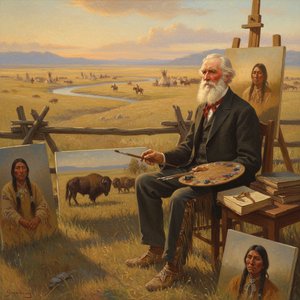
A Life of Bravery and Artistry
White Swan, also known as Mee-nah-tsee-us in the Crow language, was a Crow Scout who served with George Armstrong Custer's 7th Cavalry Regiment during the 1876 campaign. During the Battle of the Little Bighorn, he fought alongside Major Reno's detachment and was the only Crow Scout wounded in action, sustaining severe injuries to his hand, wrist, and leg. Although these wounds left him with a permanent limp and a deformed right wrist, he continued to serve as an Army scout until 1881.
In his later years at the Crow Agency, White Swan transitioned from scouting to creating drawings that depicted key events from his life, including the Battle of the Little Bighorn. These works were purchased by visitors to the battlefield and the agency. His artistic legacy includes:
- Drawings on pages from accounting ledgers.
- Paintings on larger sheets of muslin canvas.
- Illustrations of his war deeds and life events.
Legacy and Personal History
White Swan lived much of his later life at the Crow Agency in the Little Bighorn valley. Due to injuries, he was unable to hear or speak in his later years. He was known by the artist J.H. Sharp as a jolly and good-natured individual. His drawings have since been recognized by collectors and are featured in various exhibitions and collections, such as the Buffalo Bill Historical Center.
White Swan died in 1904 and is buried at the Little Bighorn National Cemetery. He left no direct descendants.
アーティストへのQ&A
カタログ内で閲覧可能なWhite Swanの作品数はいくつですか?
全作品一覧ページでは、White Swanによる作品数 1点点のアートワークをご覧いただけます。
White Swanの作品を色別に並べ替えることはできますか?
White Swanの作品は、アーティストのカラーインデックスページにて、色別に探すことができます。
White Swanの作品はどのくらい人気がありますか?
本サイトでは、White Swanの作品に関する統計情報を掲載した閲覧統計ページをご覧いただけます。
White Swanの活動年表はありますか?
White Swanの作品を時系列で辿ることができるアーティスト・クロニクルページでは、各時代ごとに章立てされ、制作順に作品が並んでいます。