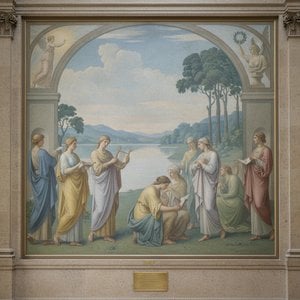
A Life of Scenic Design and Painting
Philippe Chaperon was a French painter and scenic designer who achieved significant fame through his work at the Paris Opera. His career was marked by creating stage designs for numerous 19th-century opera premieres, including works such as Verdi's Don Carlos and Aida, Massenet's Le Cid, Saint-Saëns's Henri VIII, Berlioz's Les Troyens (part two), and the first French performances of Verdi's Otello and Rigoletto, as well as Wagner's Tannhäuser.
Educated at the École des Beaux-Arts, Chaperon studied painting and architecture. His early paintings included Ruines d'un Temple dans l'Inde, which debuted at the Paris Salon of 1844, alongside landscapes of villages, cities, and church interiors. He also worked on decorative paintings and interior designs for private mansions, churches, and public buildings.
The Atelier and Theatre Contributions
Chaperon studied scenic design under Charles Cicéri and Domenico Ferri. In 1864, he formed the atelier "Rubé et Chaperon" with Auguste Alfred Rubé, producing set designs and theatre decor throughout France and Belgium for thirty years. Notable contributions include:
- The trompe-l'œil curtain for the Palais Garnier in 1875.
- The painting on the dome over the main auditorium of La Monnaie.
- A trompe-l'œil curtain for the Éden-Théâtre.
Later, alongside his son Émile, he continued producing designs for productions such as La favorite, Les Huguenots, Frédégonde, Hamlet, and Messidor. His work also extended to the Exposition Universelle in 1900 and the Municipal Casino in Biarritz.
アーティストへのQ&A
Philippe Chaperonは、どの時代に活動していましたか?
Philippe Chaperonは19th Centuryに活動していました。この時代背景は、その画家の足跡を歴史の中に位置づけるものです。
Philippe Chaperonの作品を特定のカラーパレットから探すには、どうすればよいですか?
カラーパレットから探すページでは、Philippe Chaperonの作品をカラーパレットごとに分類してご紹介しています。
Philippe Chaperonの出生地と誕生年はいつですか?
Philippe Chaperonは1823年、former 2nd arrondissement of Parisに生まれました。
Philippe Chaperonの作品を、雰囲気別に探すにはどこへ行けばよいですか?
アーティストのムードで探すページでは、Philippe Chaperonの作品をその雰囲気に合わせてご紹介しています。