Kim Ho Deuk: A Journey Through Korean Ink Landscape
Kim Ho Deuk, born in Daegu, South Korea in 1950, stands as a prominent figure in contemporary Korean ink painting—a tradition deeply rooted in Buddhist philosophy and artistic expression. His formative years were marked by rigorous academic pursuits at Seoul National University’s College of Fine Arts, culminating in degrees in both B.F.A. and M.F.A., specializing in painting. This grounding in classical techniques profoundly shaped his artistic vision, informing a lifelong dedication to exploring the profound symbolism inherent within landscape imagery.- Early Influences: Ho Deuk’s artistic sensibilities were nurtured by exposure to Zen Buddhism and its emphasis on mindfulness and contemplation—influences that permeate his oeuvre.
- Formal Training: His studies at Seoul National University provided him with a comprehensive understanding of Western art history alongside Korean painting traditions, fostering a balanced perspective on artistic innovation.
- Notable Exhibitions: Recognizing his talent early on, galleries like Hakgojae and Gallery BK championed his work, showcasing solo exhibitions that garnered critical acclaim and establishing him as a respected artist within Korea’s art community.
The Essence of Korean Ink Landscape Painting
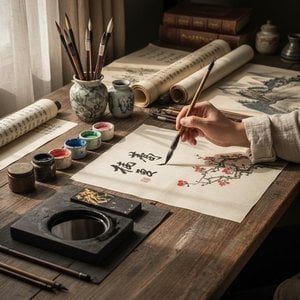
At the core of Kim Ho Deuk's artistic practice lies the meticulous execution of ink wash painting—a technique characterized by its deliberate simplicity and profound expressive power. Unlike Western landscape paintings that strive for realistic representation, Korean ink landscapes prioritize conveying emotion and spiritual insight rather than visual accuracy. The artist employs subtle gradations of tone achieved through layering washes of ink onto rice paper, creating textures that mimic the natural world while simultaneously embodying concepts of emptiness (sunyata) and interconnectedness—themes central to Buddhist cosmology.- Technique: Ho Deuk’s mastery lies in mastering the delicate balance between spontaneity and control—a hallmark of Korean ink painting tradition.
- Symbolism: Recurring motifs such as mountains, trees, and rocks are imbued with symbolic significance, representing permanence, resilience, and the cyclical nature of existence.
- Compositional Considerations: Careful attention to spatial arrangement contributes to the overall impact of each piece, guiding the viewer’s gaze and fostering contemplation about the relationship between humanity and the natural world.
Exploring Conceptual Depth Through Landscape Imagery
Kim Ho Deuk distinguishes himself from many contemporary artists by embracing a conceptual approach to landscape painting—a departure from purely descriptive representations. Drawing inspiration from Zen Buddhist texts like the Linji Lu, he seeks to capture not merely what is seen but what is felt—the underlying essence of experience itself. As expressed in the Linji Lu, “One must distinguish black and white in a split second and determine life and death in a flash of lightning,” Ho Deuk’s paintings reflect this preoccupation with immediacy and transformative insight.- Zen Influence: The concept of "now"—a state of pure presence—serves as a guiding principle for his artistic process, mirroring the Zen ideal of achieving enlightenment through mindfulness.
- Gestalt Psychology: He utilizes Gestalt principles to create visual compositions that emphasize relationships between elements—demonstrating an awareness of perceptual psychology and its impact on artistic interpretation.
- Philosophical Resonance: Like Kosuth’s “One and Three Chairs,” Ho Deuk's work engages in a dialogue with philosophical concepts, prompting viewers to consider questions of perception, reality, and the human condition.
Recognition and Legacy
Kim Ho Deuk’s artistic achievements have been recognized internationally through prestigious art fairs such as Art Basel Hong Kong and Ink Studio—solidifying his position as a leading voice in Korean contemporary art. His representation by Hakgojae Gallery ensures continued visibility for his work and contributes to the preservation of Korean ink painting traditions for future generations. Ultimately, Kim Ho Deuk’s enduring contribution lies in his ability to transform landscape imagery into vehicles for profound spiritual contemplation—a testament to the transformative power of artistic expression.Q&A
Kim Ho Deukの作品を技法別にまとめて閲覧できる場所はどこですか?
特定の技法によるKim Ho Deukの全作品をご覧いただくには、アーティストの全技法ページをご利用ください。
What other names is Kim Ho Deuk known by?
Kim Ho Deuk is also known as Kim Ho-Deuk.
Kim Ho Deukによるすべての作品を見るには、どうすればよいですか?
当サイトにおけるKim Ho Deukのすべての作品は、アーティストのすべての作品一覧ページからご覧いただけます。
Kim Ho Deuk氏の作品のカラープロファイルはどこで確認できますか?
Kim Ho Deukの作品のカラープロファイルは、アーティストのパレット・ゲノムページでご確認いただけます。
Kim Ho Deukの作品をムード別に探すことはできますか?
Kim Ho Deukの作品は、それぞれの作品が持つムード(情緒)ごとに分類されたアーティスト専用ページムード別ルームから、気分に合わせてお探しいただけます。
Kim Ho Deukの作品はどのくらい人気がありますか?
Kim Ho Deukの作品に関する統計情報は、アーティストの統計情報ページでご確認いただけます。
Kim Ho Deukの出生地と誕生年はいつですか?
Kim Ho Deukは1950年にDaeguで生まれました。
Kim Ho Deukの出身国はどこですか?
Kim Ho DeukはSouth Koreaで生まれました。