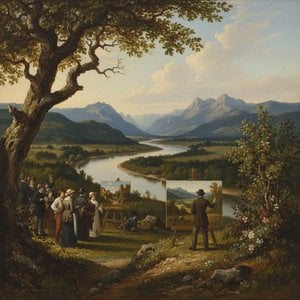
James McGarrell (1930 – 2020): A Painter of Quiet Intensity
James McGarrell (February 22, 1930 – February 7, 2020) emerged from the unassuming backdrop of Indianapolis, Indiana, embarking on a prolific artistic journey that spanned nearly seven decades and cemented his place as one of America’s most respected figurative painters. His formative years were marked by an early fascination with art—beginning painting in the basement of his parents' home at age 20—a dedication that would propel him through rigorous academic pursuits, culminating in degrees from Indiana University Bloomington and the Skowhegan School of Painting and Sculpture. These foundational experiences instilled a profound appreciation for observation and meticulous technique, shaping the distinctive style he would later champion.
- Early Influences: McGarrell’s artistic sensibilities were nurtured by exposure to European art during his Fulbright grant to Stuttgart, Germany in 1955, where he immersed himself in the traditions of German Romanticism and Impressionism. This immersion profoundly impacted his approach to landscape painting, prioritizing atmospheric subtlety and nuanced tonal gradations.
- Academic Career & Teaching Legacy: He established a distinguished academic career at Reed College in Portland, Oregon, directing the graduate painting program for three years before returning to Indiana University to oversee its expansion. His unwavering commitment to fostering artistic excellence ensured that generations of students benefited from his guidance and mentorship—a testament to his dedication as an educator.
McGarrell’s oeuvre is characterized by a remarkable consistency in subject matter: intimate interiors populated with figures rendered with quiet dignity and precision, alongside expansive landscapes imbued with a palpable sense of stillness. He eschewed grand narratives or dramatic gestures, instead favoring subtle explorations of human experience within carefully constructed environments. This stylistic preference reflects McGarrell's belief that “the most important thing is to find something you care about.”
- Technique & Style: McGarrell’s technique involved layering thin glazes of oil paint—a method honed over years of practice—to achieve luminous surfaces and subtle color harmonies. His meticulous attention to detail, combined with a masterful understanding of light and shadow, resulted in paintings that possess an unparalleled sense of realism while simultaneously conveying profound emotional resonance.
- Notable Works: Among his celebrated pieces are “Venus II,” depicting a serene female nude bathed in diffused light; “Crossing Move,” capturing the contemplative beauty of a solitary figure amidst rolling hills; and "James Madison University" showcasing impressive landscape paintings. These artworks exemplify McGarrell’s ability to distill complex emotions into deceptively simple compositions.
Throughout his prolific career, McGarrell garnered international recognition—holding solo exhibitions in America, England, France, and Italy—and his paintings were featured prominently in major museum collections across continents. He was honored with the Jimmy Ernst Lifetime Achievement Award from the American Institute of Arts and Letters in 1995, solidifying his legacy as a pivotal figure in twentieth-century art. His enduring influence continues to inspire artists today, ensuring that James McGarrell’s vision—one rooted in quiet observation and unwavering artistic integrity—remains relevant for years to come.