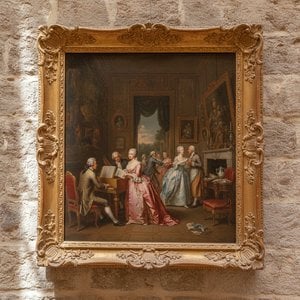
A Portraitist of Amsterdam’s Golden Age
Hillebrand Dirk Loeff (1774-1845) stands as a testament to the artistic fervor that characterized 19th-century Amsterdam – specifically, its illustrious “Golden Age.” Born into a family steeped in artistic tradition, Loeff’s formative years were spent absorbing the stylistic currents of his time, primarily under the tutelage of luminaries like Johann Herman Ehrenberg and Johann Jacob Ludovicus Duyvelshoff. These mentors instilled within him not merely technical proficiency but also an appreciation for Neoclassical ideals – a movement that championed reason, order, and idealized beauty, mirroring the intellectual landscape of Europe during the Napoleonic era.- Early Training & Academic Recognition: Loeff’s dedication to artistic pursuits quickly propelled him into membership of the Amsterdamse Tekenaar Academie (Amsterdam Drawing Academy), a prestigious institution that fostered excellence and nurtured emerging talent. Furthermore, he was honored with fellowship in organizations such as Felix Meritis – a society dedicated to promoting arts and sciences – and Koninklijke Akademie van Beeldende Kunsten (Royal Academy of Fine Arts), cementing his position within the artistic elite.
- Genre Paintings & Portraiture: Loeff’s oeuvre predominantly revolved around two genres: portrait painting and genre scenes. His portraits captured the dignity and refinement of aristocratic families, meticulously rendered with subtle shading and precise detail—characteristics emblematic of Neoclassical technique. Simultaneously, he produced evocative depictions of everyday life in Amsterdam, portraying bustling marketplaces, convivial gatherings, and intimate domestic interiors. These genre paintings offer invaluable glimpses into the social customs and artistic sensibilities of his era.
Notable Works & Artistic Style
Among Loeff’s most celebrated creations is “Portrait of Maria Adriana van der Sluys, Wife of Hermanus Martinus Eekhout,” completed in 1830-1838. This masterpiece exemplifies his mastery of Neoclassical principles—a restrained palette dominated by muted tones—and a meticulous attention to anatomical accuracy and drapery folds. The portrait’s serene expression and elegant attire convey an aura of aristocratic composure, reflecting the prevailing aesthetic standards of the period. Loeff's style consistently prioritized clarity and balance, favoring compositions that conveyed emotion without resorting to excessive ornamentation.- Influence & Legacy: Loeff’s influence extended beyond his immediate contemporaries; he served as a teacher to Ehrenberg and Duyvelshoff, passing on his artistic knowledge and shaping the careers of future artists. His membership in prominent art societies – including Koninklijke Nederlandse Akademie van Wetenschappen (Royal Dutch Academy of Sciences) and Société Royale des Beaux-Arts – underscored his commitment to intellectual discourse and artistic advancement.
- Historical Significance: Loeff’s work contributes significantly to our understanding of Amsterdam during the Romantic era, capturing a moment in time when artistic innovation intersected with social conservatism. He remains an important figure in Dutch art history, representing the culmination of Neoclassical ideals and embodying the spirit of a city at its zenith.
アーティストへのQ&A
Hillebrand Dirk Loeffの作品の中で、最も閲覧数が多いのはどれですか?
Hillebrand Dirk Loeffの作品に関する統計情報は、アーティストの閲覧統計ページでご確認いただけます。
Hillebrand Dirk Loeffの全作品を通じた色彩の使い方を詳しく知ることはできますか?
本サイトに掲載されている作品群におけるHillebrand Dirk Loeffの色彩表現は、アーティストのパレット・ゲノムページで詳しくご覧いただけます。
Hillebrand Dirk Loeffのキャリアは、どのように時代ごとに分けられていますか?
Hillebrand Dirk Loeffのアーティスト・クロニクルは、スクロールに合わせて展開するタイムライン形式となっており、アーティストのキャリアを時代ごとに章立てし、その作品群を時系列に沿ってご紹介しています。