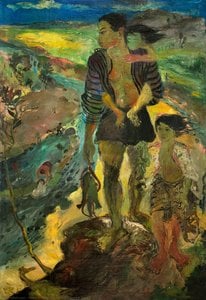
The Life and Artistic Journey of Hendra Gunawan
Born in Bandung, West Java, in the Dutch East Indies, Hendra Gunawan was the son of Raden Prawiradilaga and Raden Odah Tejaningsih. After running away from home to pursue the arts, he worked as a healer and freelance painter before meeting Affandi, who inspired him to focus on his craft. During the Japanese occupation, he gained prominence and later participated in the Indonesian National Revolution with the Pelukis Front, capturing the realities of the battlefield. His work eventually earned him a solo exhibition sponsored by President Sukarno in 1946.
Hendra's career was marked by significant political involvement. He co-established the Pelukis Rakjat artist collective and was a member of the Institute for People's Culture (LEKRA). Due to his political affiliations, he was arrested in December 1965 and held at Kebon Waru Prison for almost thirteen years without trial. Following his release in 1978, he faced health challenges and moved to Bali, where he eventually passed away in 1983.
Style and Subject Matter
Hendra Gunawan's artistic style evolved from early realism toward an increasingly impressionist approach. His works are characterized by:
His subject matter often drew from wayang (shadow puppetry), Balinese culture, and scenes of people at work, in play, or in struggle. While landscapes are rare in his oeuvre, his paintings frequently depicted the human condition, from burdened women traveling roads to historical scenes of conflict.
アーティストへのQ&A
Hendra Gunawanの作品一覧はすべて確認できますか?
本サイトにおけるHendra Gunawanのすべての作品は、アーティストの全作品一覧ページからご覧いただけます。
Hendra Gunawanの作品を主題別に探すことはできますか?
主題別アーカイブページでは、Hendra Gunawanの作品を主題別に探すことができます。
Hendra Gunawanには他にどのような名で知られているものがありますか?
Hendra Gunawanは、Raden Hendra Gunawan Prawiradilagaという別名でも表記されます。
Hendra Gunawanの作品に関する統計情報はどこで確認できますか?
本サイトでは、Hendra Gunawanの作品に関する統計情報を掲載した閲覧統計ページをご覧いただけます。