From the Pitch to the Palette: The Unexpected Journey of François Masson
The story of François Masson is one of remarkable transition, a narrative that defies easy categorization and celebrates the latent creativity often hidden beneath the surface of seemingly disparate pursuits. Born in Rennes, France, in 1979, Masson initially carved his path not with brushstrokes but with skillful footwork, establishing himself as a promising midfielder in the world of professional football. His early career saw him honing his skills at Pontivy GS, where he quickly distinguished himself with a keen eye for goal – netting thirteen times in thirty-two matches – before securing a contract with AS Cannes. A relegation followed, leading Masson to Dijon FCO in 2002, a move that would prove pivotal not only in his sporting life but also as the nascent stage of an artistic awakening.
It was during his five seasons with Dijon that the seeds of transformation were sown. Masson wasn’t merely a player on the field; he possessed a deeply observant nature, attuned to the nuances of light and shadow, form and movement – qualities that would later become hallmarks of his artistic expression. The semi-final appearance in the 2003-04 Coupe de France and the subsequent promotion to Ligue 2 were achievements earned through dedication and teamwork, but they also provided a backdrop for a growing internal shift. The departure of manager Rudi Garcia, who had initially brought him to Dijon, marked a turning point, prompting Masson to seek new horizons – not on another football pitch, but within the realm of art.
A Late Bloom: Discovering Artistic Voice
While biographical details surrounding Masson’s formal artistic training remain somewhat elusive, his emergence as an artist is particularly compelling given its unconventional origins. He didn't follow a traditional academic path; instead, he appears to have been self-directed, driven by an intrinsic need to translate the world around him onto canvas. His work quickly gravitated towards portraiture, specifically capturing the essence of individuals with a sensitivity that belies any lack of formal instruction. The Musée Thomas-Henry holds examples of his captivating portraits, including ‘Francoise-Charlotte…’, which offers a glimpse into his developing style – a blend of realism and emotional depth.
Masson’s artistic sensibility isn't rooted in grand historical movements but rather in a personal exploration of human character. His paintings aren’t about recreating likenesses; they are about revealing the inner lives of his subjects, their vulnerabilities, strengths, and untold stories. This focus on psychological insight sets him apart, creating portraits that resonate with viewers on an intimate level. He seems to have found inspiration in the 19th-century tradition of portrait painting, echoing the techniques of masters like Jean-François Millet, but infused with a distinctly modern sensibility.
Themes and Techniques: A Subtle Power
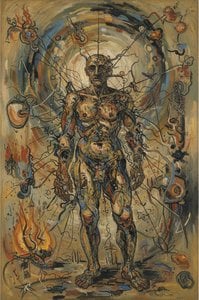
The core of Masson’s artistic practice lies in his ability to capture fleeting moments of emotion. His portraits are not static representations; they convey a sense of movement, as if the subjects are caught mid-thought or on the verge of expression. He masterfully employs light and shadow to sculpt form and create depth, drawing attention to the eyes – often considered the windows to the soul – which become focal points for emotional connection.
While details regarding his specific techniques remain limited, it’s evident that Masson possesses a refined understanding of color theory and composition. His palette tends towards muted tones, creating an atmosphere of quiet contemplation. He avoids ostentatious displays of technical virtuosity, instead prioritizing the subtle nuances of expression and the psychological impact of his work. This restraint lends his portraits a sense of authenticity and intimacy, inviting viewers to engage with the subjects on a deeper level.
Historical Significance & Legacy
François Masson’s story is significant not simply for its unusual trajectory – from professional athlete to accomplished artist – but also for what it represents: the boundless potential for human creativity. He demonstrates that artistic talent can emerge at any stage of life, regardless of prior experience or formal training. His work challenges conventional notions of artistry and celebrates the power of self-discovery.
Though his career as a footballer is well documented, his artistic legacy is still unfolding. His paintings offer a unique perspective on portraiture, blending realism with emotional depth and inviting viewers to connect with the subjects on an intimate level. As more of his work comes to light, it’s clear that François Masson is not merely a ‘footballer-turned-artist’; he is a compelling artistic voice in his own right, deserving of recognition and appreciation.