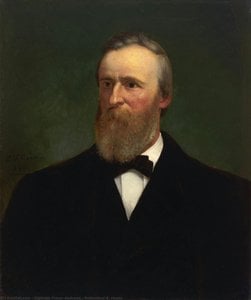
The Master of Light and Legacy: The Life of Eliphalet Frazer Andrews
In the grand tapestry of nineteenth-century American art, few threads are woven as intricately as those left by Eliphalet Frazer Andrews. Born in June 1835 in Steubenville, Ohio, Andrews emerged as a painter who possessed a rare duality of vision: the ability to capture the monumental weight of history and the quiet, breathing intimacy of a domestic corner. His journey was one of constant refinement, beginning with his academic foundations at Marietta College before venturing into the heart of the European art world. By immersing himself in the prestigious studios of Düsseldorf and Paris, studying under luminaries such as Lüdwig Knaus, Heinrich Mücke, and Léon Bonnat, Andrews absorbed a sophisticated mastery of light, shadow, and form that would later define his uniquely American sensibility.
The essence of Andrews’s artistry lies in his profound command over the atmosphere of a space. While he was widely celebrated as a premier portraitist—earning prestigious commissions to capture the dignity of figures like Rutherford B. Hayes—his true genius often revealed itself in his interior scenes. In works such as Interior and Interior of a Kitchen, one does not merely see a room; one feels the passage of time. Through the meticulous use of oil on canvas and delicate glazing techniques, he achieved a luminous quality that allowed light to dance across stone walls and weathered wood, imbuing even abandoned or neglected spaces with a haunting, palpable soul. His landscapes, too, such as the serene Edge of a Stream, demonstrate an ability to blend the pastoral charm of the American countryside with a sophisticated, almost Impressionistic touch.
A Pillar of American Artistic Institution
Beyond the canvas, Andrews’s influence on the American cultural landscape was structural and enduring. He was not merely a creator of images but a builder of institutions. His most significant contribution to the future of American art was his pivotal role in the establishment of the Corcoran School of Art in Washington D.C. Serving as its director from 1877 to 1902, he crafted an instructional curriculum that would shape generations of artists, fostering a standard of excellence that bridged European tradition with New World innovation. This commitment to pedagogy ensured that his devotion to technical precision and observational truth would outlive his own brushstrokes.
The historical significance of Andrews is further cemented by the locations where his work resides today. His paintings serve as visual chronicles of American power and heritage, with notable pieces adorning the White House and being preserved within the Smithsonian American Art Museum. Whether he was recreating the likenesses of deceased American icons or capturing the quiet dignity of a sunlit room, Andrews remained a visionary who understood that the smallest detail—a glint of light on a windowpane or the texture of a stone wall—could tell the grandest story of a nation’s spirit.
Q&A
Eliphalet Frazer Andrewsは、どの芸術運動に属していましたか?
Eliphalet Frazer Andrewsの作品は、アーティストのすべてのムーブメントページから、各ムーブメント(芸術運動)別に閲覧いただけます。
Eliphalet Frazer Andrewsの作品一覧はすべて確認できますか?
当サイトにおけるEliphalet Frazer Andrewsのすべての作品は、アーティストのすべての作品一覧ページからご覧いただけます。
Eliphalet Frazer Andrewsの活動年表はありますか?
Eliphalet Frazer Andrewsの作品を時系列で辿ることができるクロニクルページでは、各時代ごとに章立てされ、制作順に作品が並んでいます。