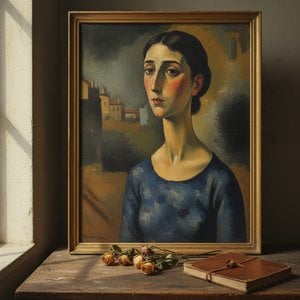
A Life Captured in Light and Line
Eduard Putra lived a life that ended far too soon, leaving behind a quiet but deeply felt collection of works that speak to the intimacy of everyday moments. Born in 1883, this Slovak artist possessed a keen eye for the subtle shifts in human expression and the stillness of a room. His years were marked by a dedication to capturing the essence of his subjects, whether through the heavy texture of oil on canvas or the delicate precision of a pencil sketch.
His presence in the art world was defined by a focus on the figurative. He found meaning in the way light fell across a face or how a person sat by a window. There is a sense of quiet observation in his work, as if he were a silent guest in the rooms he painted. His output includes a variety of subjects that reflect a deep interest in the human form and the natural world.
The Art of Observation
The works of Eduard Putra often center on the quietude of domestic life. He had a particular talent for portraiture, focusing on the nuances of a gaze or the posture of a sitter. Many of his paintings and drawings explore themes of solitude and simple tasks, such as sewing or reading. These pieces do not demand attention through grand gestures but instead invite a closer look at the details of existence.
His technical range allowed him to move between different mediums with ease:
- Oil paintings on canvas and board that capture weight and form.
- Detailed drawings that study the anatomy of heads, profiles, and limbs.
- Landscape works that ground his figurative studies in a sense of place.
In pieces like Head Study of a Young Man or Woman by a Window, one can see his commitment to the study of light. He used oil to create depth, often working on smaller scales that feel personal and direct. His drawings, particularly those from the years leading up to 1915, show a rigorous approach to studying movement and structure, from the way a man walks to the way a woman rests.
A Lasting Presence
Though his life ended in 1915, the traces of his vision remain held within important collections. His work is preserved in institutions such as the Slovak National Gallery, where his portraits and studies continue to be studied for their honest depiction of life. The existence of his sketches and paintings in various galleries ensures that his specific way of seeing the world is not lost to time.
The significance of his work lies in its sincerity. He did not seek to reinvent the world, but rather to document it with a gentle, steady hand. Through his portraits and studies, he left behind a record of faces and figures that carry the quiet dignity of their era.
アーティストへのQ&A
キーワードごとに分類されたEduard Putraの作品はどこでご覧いただけますか?
Eduard Putraの作品は、アーティストのキーワードから探すページからキーワード別に探すことができます。各キーワードには関連する作品がまとめられています。
Eduard Putraの作品の中で、最も閲覧数が多いのはどれですか?
本サイトでは、Eduard Putraの作品に関する統計情報を掲載した閲覧統計ページをご覧いただけます。
Eduard Putraの作品を技法別にまとめて閲覧できる場所はどこですか?
特定の技法によるEduard Putraの全作品をご覧いただくには、アーティストの技法別一覧ページをご利用ください。
Eduard Putraの作品を主題別に探すことはできますか?
Eduard Putraの主題別アーカイブでは、作品を主題ごとに分類してご覧いただけます。