A Life Etched in Light: The World of Édouard Riou
Édouard Riou, born in the coastal town of Saint-Servan, France, in 1833, was an artist whose name became inextricably linked with adventure and imagination. While perhaps not a household name today, his influence resonates deeply within the history of illustration, particularly for those who cherish the early works of Jules Verne. Riou wasn’t merely an illustrator; he was a visual architect of fantastical worlds, bringing to life the daring expeditions and scientific marvels penned by one of literature's greatest visionaries. His artistic journey began with formal training under
Charles-François Daubigny, known for his lyrical landscapes, and
Gustave Doré, the master of dramatic chiaroscuro. This foundational education instilled in Riou a profound appreciation for both naturalistic detail and evocative storytelling—qualities that would define his career. He graduated in 1859, poised to make his mark on the burgeoning world of illustrated literature.
The Verne Collaboration: A Partnership of Vision
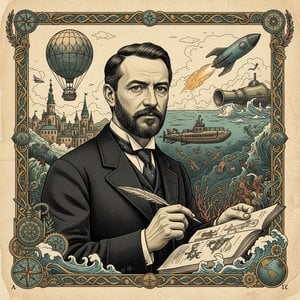
Riou’s most celebrated work stemmed from his collaboration with Jules Verne, beginning in 1865 with *Five Weeks in a Balloon*. This wasn't simply a matter of rendering text into images; it was a symbiotic relationship. Riou didn’t just illustrate the novel, he helped to *visualize* Verne’s concepts for a wider audience. The initial success led to a remarkable run of six novels illustrated by Riou: *The Adventures of Captain Hatteras*, *Journey to the Center of the Earth*, *The Children of Captain Grant*, *Twenty Thousand Leagues Under the Seas*, and *The Survivors of the Chancellor*. Each project showcased his versatility, from the airy expanses of balloon-borne adventure to the claustrophobic depths of subterranean caverns. Verne himself offered feedback on Riou’s work, requesting adjustments in scale and detail—a testament to the collaborative spirit that fueled their partnership. The illustrations weren't merely decorative; they were integral to the narrative experience, shaping how readers imagined these extraordinary tales. He was a master of wood
engraving, bringing texture and depth to his scenes.
Beyond Verne: A Broad Artistic Palette
While forever associated with Jules Verne, Riou’s artistic talents extended far beyond the realm of science fiction adventure. He wasn't solely focused on fantastical landscapes; he was a skilled landscape painter in his own right, exhibiting alongside prominent artists like
Claude Monet and
Édouard Manet in 1868. He also undertook significant commemorative work, including designs related to the opening of the Suez Canal—a project that speaks to his ability to capture grand historical moments. His illustrations weren’t limited to Verne; he lent his talents to works by
Walter Scott (*Ivanhoe*, *Waverley*), Victor Hugo (*Notre Dame de Paris*), and Louis Figuier, demonstrating a broad literary range. The work for Figuier's *La Terre avant le Deluge* (The World Before the Deluge) is particularly noteworthy, as it showcases Riou’s ability to depict prehistoric life with both scientific accuracy and dramatic flair—a fascinating intersection of art and emerging paleontological understanding.
Style and Legacy: Bridging Eras
Riou's artistic style occupies a unique position in the
19th-century landscape. He bridged the gap between earlier, more cartoonish illustration styles and the professionalized field that emerged later in the century. His work is characterized by detailed depictions of characters and environments, often employing numerous “spot” illustrations to enhance the narrative flow. He possessed a remarkable ability to convey
light and shadow, creating scenes that are both visually compelling and emotionally resonant. While his contemporaries sometimes favored
intricate detail, Riou’s strength lay in capturing atmosphere and movement—a quality particularly evident in his depictions of adventure and exploration. His influence can be seen in the subsequent generations of illustrators who sought to bring imaginative worlds to life. He became a member of the Legion of Honour, a recognition of his significant contributions to
French art and culture. Édouard Riou died in Paris on January 27, 1900, leaving behind a legacy etched not just in ink and wood, but in the collective imagination of readers worldwide.