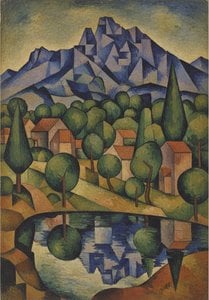
The Architecture of Light and Form
Bamberg, Germany, provides the backdrop for a life defined by the intersection of structure and color. Born in 1914, Anton Greiner enters the world of formal training at the Munich Academy of Fine Arts between 1936 and 1939. His early years are marked by the heavy realities of war and captivity, yet his focus remains fixed on the geometry of space. After returning to Munich in 1947, he refines his craft as a master student and assistant to Hermann Kaspar, specializing in the complex demands of architectural painting.
His hands move from the small scale of church apsides to the vast expanses of public facades. By 1961, he returns to his birthplace, establishing himself as a freelance artist. He does not merely paint walls; he restores the history written upon them, such as the baroque frescoes of the Old Bamberg Town Hall. His work becomes a bridge between the physical structure of a building and the spiritual or aesthetic atmosphere it holds.
A Prism of Influence
Greiner’s technique is a deliberate dialogue with the masters of form. He seeks to understand the essence of the landscape through a specific lens, often traveling to the Provence region to capture its light. His approach to oil and watercolor is shaped by two distinct pillars of modernism:
- The structural weight and color theory of Paul Cézanne.
- The prismatic, fractured compositions of Lyonel Feininger.
This synthesis results in a style where views are broken into geometric planes. He does not simply depict a scene; he reconstructs it through a prism of light and shape. His landscapes often take the form of watercolors, while his larger, more permanent works demand the permanence of oil and fresco.
The Scale of Devotion
The magnitude of his work is most evident in his ecclesiastical commissions. He moves through sacred spaces, leaving behind large-scale interventions that define the visual experience of the faithful. His hand is seen in the ceiling paintings of the Lichtenfels parish church and the frescoes of St. Vitus in Burgebrach. In Rehau, he completes the large-scale mural The 12 Apostles for the Church of the Holy Apostles. These works are not mere decorations; they are structural components of the architecture itself.
His commitment to the monumental is seen in the 20-meter-long Stations of the Cross he completed in the St. Paulus Church in Strullendorf. Whether working on the frescoes of the Maria Königin church or the walls of a local parish, Greiner’s presence is felt in the way he handles the intersection of light, shadow, and sacred geometry. He remains a central figure in the Franconian art scene, a painter of the very walls that house the history of his region.
アーティストへのQ&A
Anton Greinerの出生地と誕生年はいつですか?
Anton Greinerは1914年、Bambergに生まれました。
Anton Greinerの作品を鑑賞できる3Dバーチャルツアーはありますか?
Anton Greinerの作品は、アーティストの3Dギャラリーページにある3Dギャラリーでご覧いただけます。
Anton Greinerの活動年表はありますか?
Anton Greinerのアーティスト・クロニクルは、スクロールに合わせて展開するタイムライン形式となっており、アーティストのキャリアを時代ごとに章立てし、その作品群を時系列に沿ってご紹介しています。
美術様式別に分類されたAnton Greinerの作品は、どこで閲覧できますか?
全ムーブメントページでは、Anton Greinerの作品を美術様式別にまとめてご紹介しています。