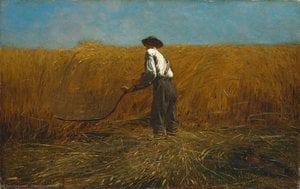
Winslow Homer’s “Warm Afternoon (Shepherdess): A Moment of Rural Tranquility
Winslow Homer, born in Boston in 1836, wasn't sculpted by the traditional European art academies that shaped so many of his contemporaries. Instead, he emerged from a distinctly American experience, one rooted in practicality and observation. His journey began not with grand historical canvases, but as a commercial illustrator at the tender age of twelve for Harper’s Weekly. This early apprenticeship was formative, honing an exceptional ability to capture scenes with clarity and detail – skills that would become hallmarks of his mature work. He wasn’t learning perspective in Paris; he was learning to *see* America, its people, and its unfolding story. The bustling streets of Boston, the quiet dignity of rural New England life, these were his first subjects, rendered with a precision born of necessity for the demands of print media. This foundation allowed him to transition into painting, initially in watercolor, before delving into gouache and graphite pencil—techniques that would become synonymous with his distinctive style.
“Warm Afternoon (Shepherdess),” painted in 1878, exemplifies Homer’s mastery of capturing everyday life with remarkable realism. Executed in gouache on gray-green wove paper, the artwork transports viewers to a serene hillside scene dominated by a shepherdess and her flock of sheep. This piece is more than just a depiction; it's an embodiment of Homer’s belief that beauty could be found in the simplest moments of rural existence. The composition skillfully utilizes light and shadow—a technique championed by luminists like George Caleb Bingham—to create depth and dimensionality, mirroring the subtle gradations of color observed in nature. As discussed in Wikipedia's article on Light in Painting, light fulfills both technical and aesthetic objectives, influencing color, texture, and volume. In “Warm Afternoon (Shepherdess)", the warm sunlight casts gentle shadows, creating a sense of warmth and inviting contemplation.
The painting’s symbolism speaks to themes of pastoral harmony and human connection with the natural world—values deeply ingrained in American Romanticism. Homer deliberately avoids melodrama or grand narrative; instead, he presents a quiet tableau that encourages viewers to appreciate the beauty of rural life and the dignity of labor. The shepherdess herself is positioned centrally, conveying a sense of calm repose amidst the activity of her flock. Her posture exudes serenity, suggesting an acceptance of the rhythms of nature and a contentment with a modest existence. This deliberate simplicity aligns perfectly with Homer’s broader artistic vision—one that prioritized observation and honest representation over idealized notions of beauty.
Beyond its aesthetic qualities, “Warm Afternoon (Shepherdess)” holds significance within the context of American art history. It represents a pivotal moment in Homer's career, marking a shift away from commercial illustration toward more ambitious landscapes and genre paintings. Like "School Time," which can be found on WahooArt, this artwork demonstrates Homer’s commitment to portraying authentic human experience—a characteristic that distinguishes him from many of his European contemporaries who favored mythological or historical subjects. For those seeking inspiration or considering a high-quality reproduction, WahooArt offers exceptional prints and canvases of Homer's celebrated works. “Warm Afternoon (Shepherdess)” by Winslow Homer, available on WahooArt "School Time" by Winslow Homer, available on WahooArt Musee des Beaux-Arts de Nancy, France, featuring European art from the 14th to the 21st century, discussed in AllPaintingsStor