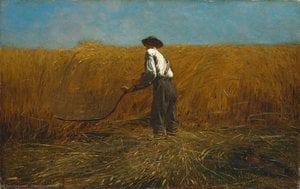
A Moment of Controlled Chaos: Winslow Homer’s “The Unruly Calf”
Winslow Homer's "The Unruly Calf," painted in 1875, isn’t merely a depiction of farm life; it’s a carefully constructed tableau brimming with quiet tension and the subtle dance between control and surrender. This oil on canvas masterpiece, currently available as a stunning hand-painted reproduction at WahooArt.com, offers a profound glimpse into Homer's masterful ability to capture the essence of rural America while simultaneously hinting at deeper human complexities. The painting immediately draws the eye to a man, his posture suggesting both determination and a touch of weary patience, attempting to manage a spirited calf in a sun-drenched field. Around him, other cows graze peacefully, creating a visual counterpoint to the central drama – a deliberate choice that amplifies the feeling of contained struggle. Homer’s skill lies not just in rendering the physicality of the animals and the landscape, but in conveying an unspoken narrative through gesture and expression.
The Realist's Eye: Composition and Technique
Homer’s approach to painting firmly rooted him within the American Realism movement, a style that sought to portray everyday life with unflinching honesty and without resorting to romanticized embellishment. He meticulously observed his subjects – in this case, the practical realities of farm work – and translated those observations onto canvas with remarkable precision. The composition is carefully balanced; the man occupies a central position, yet he’s not dominating the scene. Instead, he's integrated within it, a participant in a timeless ritual. Homer’s use of oil paint allows for an incredible depth of color and texture. Bold brushstrokes, particularly evident in the rendering of the calf’s coat and the rough grasses beneath its hooves, inject a sense of energy and movement into the scene. Notice how he subtly shifts light and shadow to create volume and form – a technique honed during his early career as an illustrator, where capturing realistic detail was paramount. The background cows, rendered with looser brushwork, recede into the distance, reinforcing the feeling of space and contributing to the overall sense of tranquility despite the central conflict.
Symbolism and Narrative Depth
Beyond its surface depiction of a simple farm scene, “The Unruly Calf” resonates with layers of symbolic meaning. The calf itself can be interpreted as representing youthful rebellion, untamed spirit, or perhaps even the challenges of adolescence. The man’s struggle to control it speaks to the universal themes of authority, responsibility, and the delicate balance between guidance and freedom. Interestingly, research suggests that Homer may have intended a deeper resonance with Reconstruction-era America, with the calf's defiance potentially symbolizing the struggles for self-determination faced by African Americans at the time. The presence of the plow in the background subtly alludes to labor and the cycle of agricultural life – a constant negotiation between human effort and the natural world. A fascinating study for this piece, held at the Brooklyn Museum, further illuminates Homer’s process and hints at these layered interpretations.
A Legacy of American Art: Homer and Beyond
Winslow Homer (1836-1910) was a pivotal figure in American art history, forging his own distinct path away from European artistic conventions. His early work as an illustrator instilled in him a keen eye for detail and a deep understanding of visual storytelling – skills that he brought to his paintings with unparalleled skill. His ability to capture the spirit of rural America, coupled with his masterful use of color and brushstroke, cemented his place as one of the most important American Realist painters. Explore more of Homer’s work, including his iconic “Weaning the Calf,” at WahooArt.com, where you can find a stunning hand-painted reproduction of "The Unruly Calf" to grace your home or office. For further insight into this era and movement, consider exploring resources like Wikipedia's entry on American Realism and the North Carolina Museum of Art’s online collection. And if you appreciate the work of Henry William Brewer, a contemporary British artist known for his detailed cityscapes, or Arthur Boyd Houghton, whose Pre-Raphaelite influences are evident in his illustrations, you can discover more about this rich artistic landscape on our site.