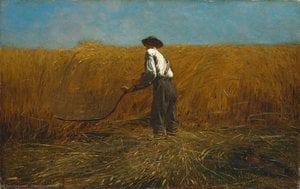
迅速な制作と多彩な仕上げオプションを備えた、ミュージアムクオリティのジークレーまたはキャンバスプリント。 ( 手描きの絵画を購入 デジタル画像販売へ切り替え)





























作品のオリジナル比率に合わせた、当店の規定サイズからお選びください。

特定のフレームやスペースに合わせて、ご自身でサイズを指定することも可能です。選択されたサイズが元の画像の比率と一致しない場合、作品をトリミングするか、鏡面反射または単色での塗りつぶしによって画像を拡張いたします。制作を開始する前に、ご確認用のデジタルモックアップをお送りいたします。
画面上のプレビューには、実際のトリミングや拡張は反映されませんのでご注意ください。最終的な構図を正確に確認できるのは、モックアップのみとなります。
カスタムサイズも承っておりますが、元の比率を維持するためには、あらかじめ用意されたリストからサイズを選択することをお勧めいたします。

The Busy Bee
複製画のサイズ
Winslow Homer’s “The Busy Bee,” painted around the late 19th century, is more than just a depiction of a young boy; it’s a poignant snapshot of American life rendered with the meticulous observation and understated emotional power that defined Homer’s career. The painting captures a fleeting moment – a boy in a straw hat, seemingly absorbed in his task, set against a backdrop of rural New England tranquility. This isn't a grand historical scene or an idealized pastoral; it’s a grounded portrayal of everyday existence, reflecting Homer’s deep connection to the American spirit and his commitment to portraying scenes with remarkable clarity and detail.
Homer's mastery lies in his ability to translate observation into paint with remarkable precision. Executed primarily in black and white, “The Busy Bee” exemplifies his signature style – a blend of realism and tonal subtlety. The use of shading is particularly noteworthy, creating a strong sense of volume and texture within the boy’s clothing and the surrounding environment. This technique, honed during his years as an illustrator for Harper's Weekly, allowed him to capture not just the appearance but also the *feeling* of a scene – the light, the atmosphere, the very essence of the moment. The lack of color intensifies the focus on form and texture, echoing the stark clarity often found in journalistic illustration.
"The Busy Bee" transcends a simple portrait of a boy; it’s imbued with subtle symbolism. The boy’s determined expression suggests ambition, resilience, and perhaps even the burdens of responsibility – qualities often associated with the American character. The presence of the birds adds an element of freedom and aspiration, while the potted plant introduces a touch of domesticity and connection to nature. The painting evokes a sense of quiet contemplation and nostalgia, inviting viewers to reflect on themes of childhood, work, and the passage of time. It’s a testament to Homer's ability to capture not just what he saw, but also what he *felt* about it.
Painted during a period of significant social and economic change in America – the late 19th century – “The Busy Bee” reflects Homer’s fascination with depicting the lives of ordinary people. His work, rooted in his experiences as an illustrator and his deep connection to the American landscape, helped solidify his place as one of the most important figures in American art. Reproductions of this evocative piece offer a window into a bygone era, allowing us to appreciate Homer’s artistic vision and his enduring contribution to the nation's cultural heritage.


1836 - 1910 , アメリカ合衆国

Explore the profound beauty of American Realism. From Winslow Homer’s rural landscapes to the dignity of everyday life, discover how master artists captured the soul of a nation through evocative oil paintings and timeless fine art techniques.


 プレビュー
プレビュー
 シェアする
シェアする シェアする
シェアする
 詳細を見る
詳細を見る

 ダウンロード
 似ている作品
 X線調査
X線調査 スライドショー
 統計情報
統計情報

 詳細を見る
詳細を見る









 ガラスオプションは、110cm未満のサイズでのみご利用いただけます。