GraphiteWallArtAmerican Realism
 187819th Century
 9.0 x 22.0 cm
当社のアーティストが、お客様のご希望のサイズと額縁に合わせて、キャンバスに手描きで制作する油彩画です。 ( プリント版に切り替え デジタル画像販売へ切り替え)





























作品のオリジナル比率に合わせた、当店の規定サイズからお選びください。

特定のフレームやスペースに合わせて、ご希望のサイズをご入力いただけます。選択されたサイズが元の画像の比率と異なる場合、アートワークをトリミングするか、手描きで要素を追加して絵画を拡張いたします。デジタルモックアップ を制作し、制作開始前にご確認(承認)をいただきます。
画面上のプレビューは、実際のトリミングや拡張を正確に反映しているものではありません。最終的な構図は、モックアップによってのみ正確にご確認いただけます。
カスタムサイズもご利用いただけますが、元の比率を維持するためには、あらかじめ用意されたリストからサイズを選択することをお勧めいたします。

Sheep
複製画のサイズ
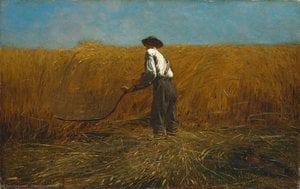
In the vast tapestry of American Realism, few works capture the profound stillness of rural existence as poignantly as Winslow Homer’s 1878 masterpiece, “Sheep.” This is not merely a depiction of livestock grazing in a meadow; it is a distilled essence of the American spirit—a quiet observation of pastoral life imbued with an understated, almost monumental grandeur. Through his masterful command of tonal shading and textural detail, Homer invites the viewer into a world where time seems to decelerate, allowing for a deep, meditative connection with the landscape. Executed with a delicate yet powerful hand in dark graphite and white gouache on vat-dyed wove paper, the piece transcends its simple subject matter to become a window into the soul of late 19th-century New England.
The composition presents a flock of sheep scattered across a sunlit meadow, their forms rendered with such precision that one can almost feel the weight of their presence against the earth. Homer deliberately eschewed the grand, sweeping historical narratives favored by many of his contemporaries, choosing instead to find the extraordinary within the ordinary. By focusing on these everyday scenes, he established a visual language rooted in authenticity and truth. The technique is nothing short of remarkable; the graphite underdrawing provides a sturdy, structural foundation, while the application of white gouache lends a luminous quality to the composition. This interplay of light and shadow creates a breathtaking illusion of three-dimensionality, drawing the eye through the depth of the field and making the sheep appear as tangible, living entities standing upon the textured ground.
Beyond its immediate visual charm, “Sheep” carries a profound symbolic weight that resonates with the themes of the Romantic movement. Throughout art history, sheep have served as enduring symbols of innocence, simplicity, and pastoral tranquility. In this work, Homer utilizes these archetypes to evoke a sense of peace and stability, offering a serene counterpoint to the burgeoning industrialization of the era. The painting captures a quintessential image of rural life that feels both timeless and deeply rooted in a specific historical moment. There is a wistful beauty in the way the light touches the fleece, suggesting a world of quiet dignity and unhurried rhythms.
For the discerning collector or interior designer, this artwork offers more than just aesthetic pleasure; it provides an emotional anchor. The monochromatic palette, characterized by its classic and timeless appearance, allows the piece to integrate seamlessly into a variety of sophisticated environments. Whether placed in a sun-drenched gallery or a moody, contemporary study, the high contrast and masterful shading of Homer’s work command attention without overwhelming the space. It is an invitation to pause, to breathe, and to rediscover the beauty found in the most humble corners of the natural world.


1836 - 1910 , アメリカ合衆国

Explore the profound beauty of American art history. From the Hudson River School to iconic landscapes, discover a curated journey through the masterpieces that defined a nation's spirit and the enduring legacy of American Romanticism.

Explore the profound beauty of American Realism. From Winslow Homer’s rural landscapes to the dignity of everyday life, discover how master artists captured the soul of a nation through evocative oil paintings and timeless fine art techniques.


 プレビュー
プレビュー
 シェアする
シェアする シェアする
シェアする
 詳細を見る
詳細を見る

 ダウンロード
 似ている作品
 X線調査
X線調査 スライドショー
 統計情報
統計情報 詳細を見る
詳細を見る









 ガラスオプションは、110cm未満のサイズでのみご利用いただけます。


![Indian Tobacco Shop Sign [reverse, Indian Facing Right] — ウィンズロー・ホマー, Contemporary Realism](/media/artworks/images-thumb/74/22/7422432cafc295265ef3b7f7fa62d35d.jpg)