迅速な制作と多彩な仕上げオプションを備えた、ミュージアムクオリティのジークレーまたはキャンバスプリント。 ( 手描きの絵画を購入 デジタル画像販売へ切り替え)





























作品のオリジナル比率に合わせた、当店の規定サイズからお選びください。

特定のフレームやスペースに合わせて、ご自身でサイズを指定することも可能です。選択されたサイズが元の画像の比率と一致しない場合、作品をトリミングするか、鏡面反射または単色での塗りつぶしによって画像を拡張いたします。制作を開始する前に、ご確認用のデジタルモックアップをお送りいたします。
画面上のプレビューには、実際のトリミングや拡張は反映されませんのでご注意ください。最終的な構図を正確に確認できるのは、モックアップのみとなります。
カスタムサイズも承っておりますが、元の比率を維持するためには、あらかじめ用意されたリストからサイズを選択することをお勧めいたします。

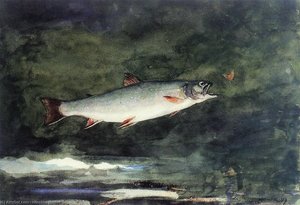
Leaping Trout 1
複製画のサイズ
To encounter Winslow Homer’s “Leaping Trout” is to step directly into the pulse of the American wilderness. Completed in 1889, this masterpiece transcends mere biological illustration, offering instead a profound meditation on the raw, unyielding energy of nature. During an era when much of the art world was preoccupied with grand European narratives and historical epics, Homer turned his gaze inward toward the rugged landscapes of the Adirondack Mountains. In this work, he does not simply depict fish in water; he captures the very breath of the wild, translating the subtle, shimmering transitions of light and movement into a canvas that feels vibrantly alive.
The scene centers on a breathtaking moment of kinetic drama: three trout battling for dominance amidst the rhythmic ripples of a serene mountain pool. One fish propels itself upward with singular purpose, breaking the surface in a display of pure, instinctive strength. This choice of perspective—focusing on the subject's struggle rather than the observer's triumph—is what makes the piece so deeply immersive. The viewer is not a distant fisherman watching from the bank, but an intimate witness to the frantic, beautiful struggle for survival. The presence of birds gliding above and perching nearby adds layers of life to the composition, creating a dynamic ecosystem where every element is caught in a fleeting, eternal moment of motion.
Homer’s technical brilliance in “Leaping Trout” lies in his ability to manipulate the medium of watercolor to achieve an almost ethereal luminosity. While his roots were in the precise world of commercial illustration, his mature style embraced a more fluid, impressionistic sensibility. He eschewed rigid outlines in favor of capturing the ephemeral quality of light reflecting off a disturbed water surface. Through a masterful layering of washes, colors bleed into one another with a soft, organic grace that mirrors the fluidity of the Adirondack streams.
One of the most captivating aspects of his technique is the use of scraping—a method where Homer would use a blunt or sharp tool to remove softened paint and paper fibers from the wet surface. This deliberate manipulation creates brilliant, textured highlights that mimic the dazzling sparkle of sunlight dancing upon the lake. These tactile imperfections lend the water a sense of depth and brilliance, making the ripples appear to move even as the viewer stands still. It is this marriage of meticulous observation and experimental technique that allows the painting to resonate with such profound emotional clarity.
For the art lover, the collector, or the interior designer, “Leaping Trout” offers much more than visual beauty; it provides a sense of tranquility intertwined with vitality. The cool palette of blues, silvers, and earthy tones makes it an exquisite centerpiece for spaces designed to evoke peace and natural elegance. Whether placed in a sun-drenched study or a sophisticated contemporary living room, the painting acts as a window into an unspoiled world, bringing the restorative power of the American landscape indoors.
Owning a high-quality reproduction of this work allows one to preserve a piece of American art history. It serves as a reminder of a time when artists sought truth in the quietest corners of the earth. As a tribute to Winslow Homer’s ability to find the extraordinary within the ordinary, “Leaping Trout” remains an essential acquisition for those who seek to surround themselves with art that possesses both technical mastery and a soul-stirring connection to the natural world.

1836 - 1910 , アメリカ合衆国

Explore the captivating world of watercolor painting! Discover its rich history, essential techniques, influential artists & collecting tips. A comprehensive guide for art enthusiasts from WahooArt.

ウィンスロー・ホーマーの傑作25選。アメリカ美術を代表する画家、風景画から海洋画まで、その感動的な絵画の世界を探求。WahooArtで複製画やアートプリントを手に入れ、お部屋に名画の輝きを。コレクションはこちら: WahooArt.com

Explore the captivating history of watercolor painting, from ancient techniques to modern masters like Kandinsky & Blake. Discover essential artists, collecting tips & the emotional power of this luminous medium. Expert insights for art enthusiasts.

Journey through 10 legendary watercolor masterpieces by Sargent, Turner & Homer! Explore iconic landscapes, portraits & floral art that redefined history. Find museum-quality reproductions and curated decor ideas at WahooArt.com.

Explore the captivating world of watercolor painting! Discover its rich history, essential techniques, influential artists & collecting tips from art experts. A comprehensive guide for enthusiasts.


 プレビュー
プレビュー
 シェアする
シェアする シェアする
シェアする
 詳細を見る
詳細を見る ガイド
ガイド

 ダウンロード
 似ている作品
 X線調査
X線調査 スライドショー
 統計情報
統計情報

 詳細を見る
詳細を見る









 ガラスオプションは、110cm未満のサイズでのみご利用いただけます。