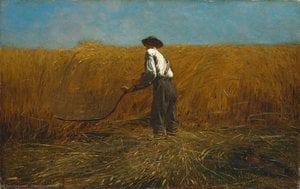
迅速な制作と多彩な仕上げオプションを備えた、ミュージアムクオリティのジークレーまたはキャンバスプリント。 ( 手描きの絵画を購入 デジタル画像販売へ切り替え)





























作品のオリジナル比率に合わせた、当店の規定サイズからお選びください。

特定のフレームやスペースに合わせて、ご自身でサイズを指定することも可能です。選択されたサイズが元の画像の比率と一致しない場合、作品をトリミングするか、鏡面反射または単色での塗りつぶしによって画像を拡張いたします。制作を開始する前に、ご確認用のデジタルモックアップをお送りいたします。
画面上のプレビューには、実際のトリミングや拡張は反映されませんのでご注意ください。最終的な構図を正確に確認できるのは、モックアップのみとなります。
カスタムサイズも承っておりますが、元の比率を維持するためには、あらかじめ用意されたリストからサイズを選択することをお勧めいたします。

A Summer Night 1
複製画のサイズ
Winslow Homer's "A Summer Night 1," painted in 1890, isn’t merely a depiction of a seaside scene; it’s an immersive experience—a shimmering portal into a world where light dances on water and human figures dissolve into the vastness of the night. This evocative work, housed today within the Musée d'Orsay in Paris, stands as a pivotal moment in American art, bridging the gap between the realism of his early career and the burgeoning Symbolism that would soon define much of European painting. Homer, born in Boston in 1836, deliberately eschewed the rigid academic training prevalent at the time, instead forging his own path through observation and an acute understanding of light and atmosphere—qualities he honed initially as a commercial illustrator for Harper’s Weekly.
The scene unfolds along a gently receding shoreline, dominated by deep blues and blacks that suggest both the mystery and the tranquility of a summer night. Homer masterfully employs loose brushstrokes, creating a textured surface that seems to ripple with movement—a subtle but insistent current pulling the viewer into the heart of the painting. The figures, rendered in muted tones and often partially obscured by shadow, are not sharply defined individuals but rather suggestions of humanity engaged in activity: running towards the viewer, standing as observers, lost in contemplation. This deliberate ambiguity invites interpretation, allowing each viewer to project their own emotions and experiences onto the scene.
Homer’s technique is a fascinating blend of Impressionism and Realism. He captures the fleeting effects of light with an almost Monet-esque sensitivity, layering paint in thin washes to create luminous highlights on the water and a hazy glow around the figures. Yet, unlike pure Impressionists, Homer retains a grounding in observation—the composition feels carefully considered, not simply a spontaneous recording of visual sensations. The impasto technique – applying thick layers of paint directly to the canvas – adds another layer of texture and dynamism, particularly noticeable in the waves and the suggestion of movement across the water. This tactile quality further enhances the sense of immersion within the painting.
The color palette is restrained but powerfully effective. The dominant blues and blacks are punctuated by flashes of white light reflecting off the water, creating a dramatic contrast that draws the eye and establishes a strong sense of depth. Homer’s use of complementary colors—particularly the juxtaposition of blue and orange – intensifies these effects, adding to the painting's overall vibrancy. He doesn’t simply paint what he *sees*; he paints how it *feels* to see it at night.
“A Summer Night” is rich in symbolic meaning, reflecting Homer’s broader exploration of the American experience. The scene evokes themes of movement, emotion, and a fleeting moment captured in time—a quintessential Romantic subject matter. The figures running towards the viewer suggest an urgency, a desire for connection or perhaps simply a joyful embrace of life's momentum. The painting can be interpreted as a meditation on the relationship between humanity and nature, capturing a sense of both wonder and vulnerability.
Interestingly, Homer’s work was influenced by his time in Paris, where he encountered Impressionist techniques and Symbolist ideas. However, he skillfully integrated these influences into his own distinct style, creating a uniquely American vision—one that celebrates the beauty and drama of the natural world while simultaneously exploring the complexities of human emotion. The painting's title itself – “A Summer Night” – hints at this duality, suggesting both the idyllic pleasures of summer and the underlying mysteries of the night.
“A Summer Night” remains a powerfully resonant work of art, offering a glimpse into a bygone era while simultaneously speaking to universal themes. Its evocative imagery and masterful technique make it an ideal choice for interior design—its luminous quality and sense of movement would bring a touch of drama and tranquility to any space. For art collectors, this painting represents a pivotal moment in American art history, showcasing Homer’s exceptional talent and his ability to capture the essence of a fleeting moment with breathtaking beauty. Reproductions, skillfully crafted by WahooArt.com, offer an accessible way to experience the magic of this iconic masterpiece.

1836 - 1910 , アメリカ合衆国

Explore the ethereal beauty of Impressionist landscapes. Discover how masters like Monet captured fleeting light through color and texture, and learn to curate these timeless, luminous masterpieces for your home collection.


 プレビュー
プレビュー
 シェアする
シェアする シェアする
シェアする
 詳細を見る
詳細を見る ガイド
ガイド

 ダウンロード
 似ている作品
 X線調査
X線調査 スライドショー
 統計情報
統計情報

 詳細を見る
詳細を見る









 ガラスオプションは、110cm未満のサイズでのみご利用いただけます。