
x


迅速な制作と多彩な仕上げオプションを備えた、ミュージアムクオリティのジークレーまたはキャンバスプリント。 ( 手描きの絵画を購入 画像を購入)
作品のオリジナル比率に合わせた、当店の規定サイズからお選びください。

特定のフレームやスペースに合わせて、ご自身でサイズを指定することも可能です。選択されたサイズが元の画像の比率と一致しない場合、作品をトリミングするか、鏡面反射または単色での塗りつぶしによって画像を拡張いたします。制作を開始する前に、ご確認用のデジタルモックアップをお送りいたします。
画面上のプレビューには、実際のトリミングや拡張は反映されませんのでご注意ください。最終的な構図を正確に確認できるのは、モックアップのみとなります。
カスタムサイズも承っておりますが、元の比率を維持するためには、あらかじめ用意されたリストからサイズを選択することをお勧めいたします。

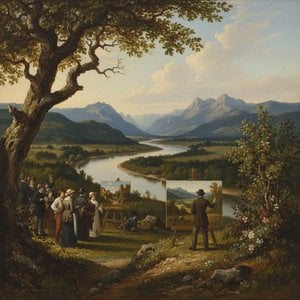
Catering For The Convent
複製画のサイズ

William Samuel Parrott (1844-1915) stands as a pivotal figure in American landscape painting, particularly renowned for his breathtaking depictions of Oregon and the Pacific Northwest. Emerging during a period of significant artistic innovation known as the Luminist movement, Parrott mastered the art of capturing atmospheric effects and conveying profound mood through subtle tonal gradations rather than mere detailed realism. This stylistic approach profoundly shaped his entire oeuvre, establishing him as one of the foremost interpreters of the region's dramatic and untamed vistas.
His formative years were marked by a deep exposure to European art trends, notably the burgeoning influence of Impressionism. However, Parrott remained steadfast in his adherence to Luminist principles, seeking a spiritual connection with the landscape through light. Influenced heavily by masters such as Frederic Church and Asher Durand, Parrott sought to emulate their ability to evoke deep emotion through carefully observed light and color—a skill that would eventually become his artistic trademark. His process was uniquely rigorous; he meticulously studied geological formations and topographic maps, translating scientific data into evocative visual representations that possessed both accuracy and soul.
The breadth of Parrott’s prolific output is staggering, spanning several decades and encompassing over 300 paintings. His primary focus remained the majestic mountainous landscapes—most notably the iconic Mount Hood—and the expansive, winding river valleys that define the American West. To achieve the ethereal quality for which he is celebrated, Parrott skillfully employed complex glazing techniques. By layering translucent washes of pigment onto textured surfaces, he achieved a remarkable sense of luminosity and internal depth.
The resulting images are characterized by several distinct artistic elements:
His paintings are far more than mere representations of scenery; they serve as meditations on nature's grandeur and its capacity to inspire human contemplation. Through his brush, the rugged terrain of the Pacific Northwest is transformed into a realm of quiet majesty.
Beyond his regional focus, Parrott’s work reflects a broader historical movement in 19th-century American art, where the exploration of the frontier coincided with a desire to find a unique national aesthetic. While he is celebrated for his landscapes, his versatility occasionally touched upon other genres and styles, as seen in works like “Bal De La Ville De Paris,” which showcased a different, more vibrant side of his compositional ability.
Today, the historical significance of William Samuel Parrott lies in his ability to bridge the gap between scientific observation and romantic expression. He captured a specific moment in American history when the West was being documented with both wonder and precision. His dedication to the interplay of light and topography ensures that his canvases remain timeless windows into the luminous beauty of a vanishing era, leaving an indelible mark on the tradition of American landscape painting.

1844 - 1915

ロマン派絵画の時代を彩る10選。巨匠たちの風景が織りなす感動の世界へ。ターナー、ルーベンスなど、名作の裏話と高精細複製でアートをお部屋に。WahooArt.comで至福のアート体験を。

Explore the captivating world of 19th-century landscape painting! Discover renowned artists like Friedrich & Monet, key movements, and find the perfect artwork to bring nature's serenity into your home. Expert insights at WahooArt.

Explore the rich history of landscape art with WahooArt. Discover renowned artists, movements like Impressionism & Romanticism, and expert guidance for collecting timeless pieces. Find your perfect serene escape today!
Explore the captivating genre scenes of Thomas George Webster, a Victorian painter bridging British traditions with American themes. Discover his style, influences & legacy in 19th-century art history.

Explore the captivating landscapes of Herman Herzog, a pivotal American artist known for his realistic depictions of Yosemite & Florida scenes. Discover his legacy, artistic journey, and market value with WahooArt.


最新の美術ニュース、限定オファー、そしてインテリアのアイデアをいち早くお届けします。
お客様のプロジェクトについてお聞かせください。当社の美術専門家が、お客様に合わせた3つのパーソナライズされた芸術提案をご提供いたします。
あなたにぴったりの3作品を無料で厳選いたします


 プレビュー
プレビュー
 シェアする
シェアする シェアする
シェアする
 詳細を見る
詳細を見る

 ダウンロード
 似ている作品
 X線調査
X線調査 スライドショー
 詳細を見る
詳細を見る






































 ガラスオプションは、110cm未満のサイズでのみご利用いただけます。


