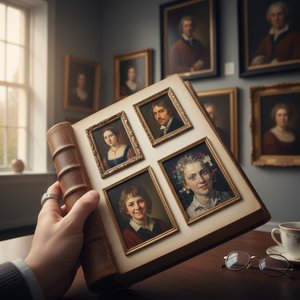
The Master of the Victorian Keepsake
In the heart of the nineteenth century, a period defined by profound social transformation and the rise of a new aristocratic elegance, William Gush emerged as a preeminent chronicler of the human face. Born near London in 1813, Gush possessed an innate ability to capture more than mere physical likeness; he mastered the art of the keepsake, a genre of portraiture intended to serve as a permanent vessel for family remembrance and emotional connection. His journey into the heights of the British art world began with remarkable precocity, as evidenced by his early appointment as a copyist at the National Gallery in London at the tender age of eleven. This foundational exposure to the great masters of the past instilled in him a reverence for classical composition and a technical precision that would become the hallmark of his prolific career.
Gush’s artistic evolution was deeply shaped by the intellectual currents of his time, drawing significant inspiration from the dramatic lighting of Benjamin Haydon and the profound aesthetic theories of John Ruskin. Through these influences, he developed a sophisticated command of chiaroscuro, using the interplay of light and shadow to imbue his subjects with a sense of psychological depth and presence. His work was never merely decorative; rather, it sought to find the soul beneath the silk and lace of Victorian fashion. This commitment to realism and emotional resonance allowed him to navigate the diverse social strata of his era, from the high-ranking nobility to the rising professional classes, documenting the faces of an empire in transition.
A Legacy of Royal Academy Excellence
The trajectory of Gush’s career was marked by consistent recognition within the most prestigious artistic institutions of England. His frequent presence at the Royal Academy—where he exhibited no fewer than fifty-three canvases—solidified his status as a cornerstone of the Victorian art establishment. This professional success was punctuated by significant accolades, most notably the Gold Isis Medal from the Society for the Encouragement of Arts, Manufacturing and Commerce, an honor that reflected both his technical mastery and his contribution to the cultural fabric of London. His reach extended beyond the borders of England as well, as seen in his travels to Canada in 1858, which broadened his perspective and added a global dimension to his repertoire of subjects.
The sheer volume of Gush’s output is a testament to his tireless dedication to his craft. With over 354 known portraits, his oeuvre serves as an invaluable historical archive. His commissions were as varied as they were prestigious, featuring notable figures such as:
- Sir John Harrison Yallop, the late Mayor of Norwich, captured in a pivotal early work from 1833.
- The Duke of Beaufort, depicted with the grandeur of the Gloucester Yeomanry Cavalry.
- High-ranking military leaders like Lieutenant General Sir William Fenwick Williams.
- Ecclesiastical figures including the Lord Bishop of Gloucester and Bristol.
Beyond the individual portraits, Gush’s historical significance lies in his ability to synthesize the Neoclassical ideals of his training with the burgeoning Romanticism of the Victorian age. His paintings, such as the evocative Reverend Richard Treffrey or the tenderly composed Rhoda and Sophia Baird, demonstrate a versatility that allowed him to pivot between formal, authoritative portraiture and intimate, familial studies. Through his brush, the ephemeral moments of nineteenth-century life were rendered permanent, leaving behind a legacy of light, shadow, and enduring human dignity.


 設置イメージを表示
 シェアする
シェアする シェアする
シェアする
 詳細を見る
詳細を見る ガイドを表示

 ダウンロード
 似ている作品
 X線調査
X線調査 スライドショーを表示
 Q&A
Q&A
 統計情報
統計情報


 詳細を表示
詳細を表示
 プリント版に切り替え





































 ガラスオプションは、110cm未満のサイズでのみご利用いただけます。