
x


 CeramicsArts and Crafts
 1897
1897 46.0 x 15.0 cm
 ロサンゼルス・カウンティ・ミュージアム・オブ・アート
迅速な制作と多彩な仕上げオプションを備えた、ミュージアムクオリティのジークレーまたはキャンバスプリント。 ( 手描きの絵画を購入 画像を購入)
作品のオリジナル比率に合わせた、当店の規定サイズからお選びください。

特定のフレームやスペースに合わせて、ご自身でサイズを指定することも可能です。選択されたサイズが元の画像の比率と一致しない場合、作品をトリミングするか、鏡面反射または単色での塗りつぶしによって画像を拡張いたします。制作を開始する前に、ご確認用のデジタルモックアップをお送りいたします。
画面上のプレビューには、実際のトリミングや拡張は反映されませんのでご注意ください。最終的な構図を正確に確認できるのは、モックアップのみとなります。
カスタムサイズも承っておりますが、元の比率を維持するためには、あらかじめ用意されたリストからサイズを選択することをお勧めいたします。

Persian
複製画のサイズ
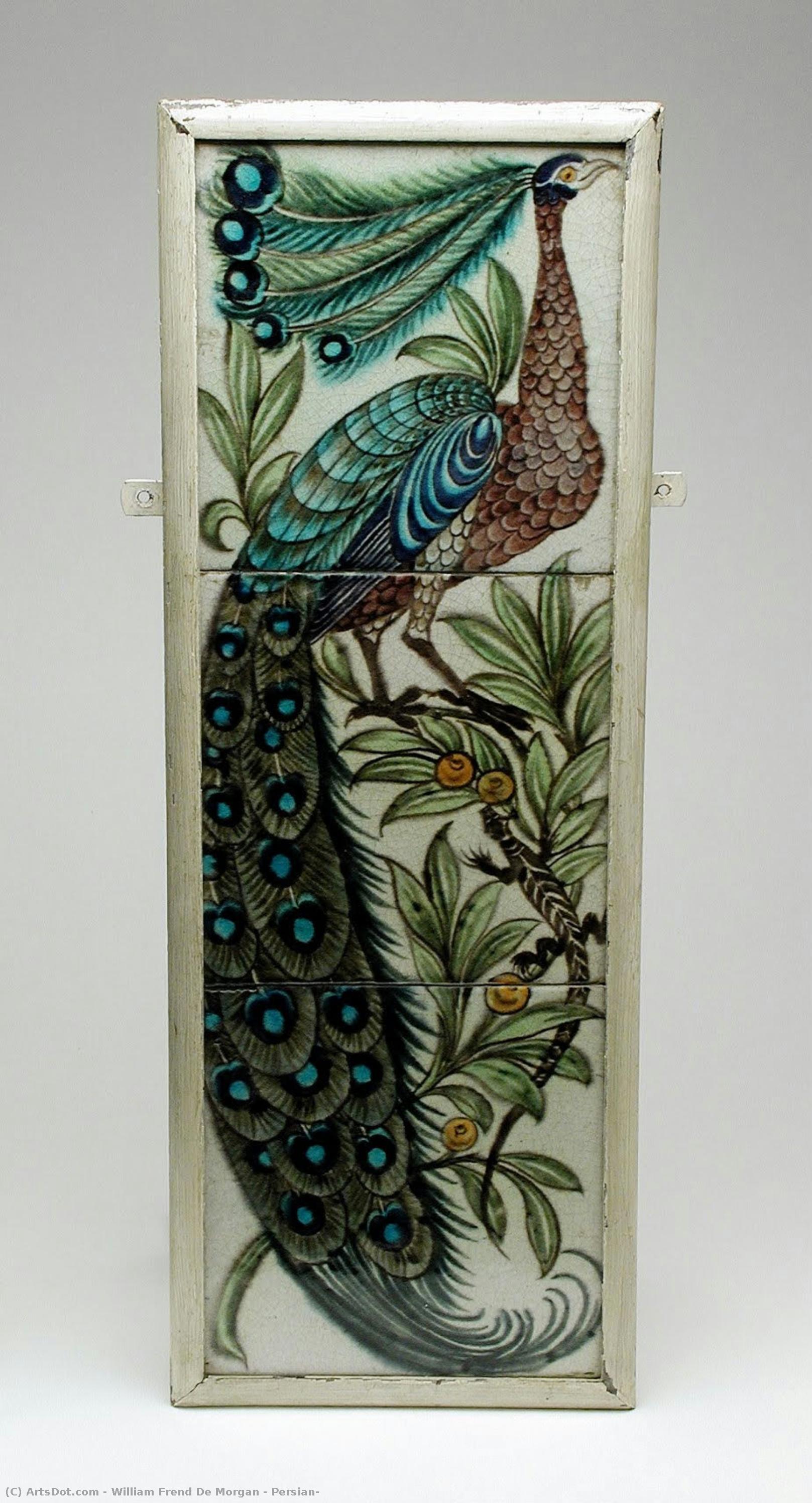
Within the rich tapestry of 19th-century decorative arts, few pieces possess the captivating blend of artistry and exoticism as William Frend De Morgan’s “Persian” tile panel. Created in 1888-1897 during his prolific period at Merton Abbey, this work transcends mere ornamentation; it's a portal to a reimagined East, infused with Victorian sensibilities and a profound understanding of ancient artistic traditions. More than just a decorative object, it’s a testament to De Morgan’s innovative spirit and his ability to synthesize diverse influences into a singularly beautiful whole.
The panel immediately draws the eye with its vibrant palette – deep blues reminiscent of Persian Iznik ware, punctuated by turquoise highlights, manganese purples hinting at ancient dyes, and the warm glow of Indian red. These colors aren’t simply applied; they are meticulously layered to create a luminous depth that seems to shift and shimmer in the light. The intricate design is dominated by stylized peacocks, their tails spread in an explosion of feathers, each feather rendered with painstaking detail. Surrounding these majestic birds are delicate floral motifs – lotus blossoms, irises, and stylized leaves – all arranged within a complex geometric framework. This combination of natural forms and structured patterns speaks to De Morgan’s fascination with both the organic beauty of nature and the order inherent in ancient civilizations.
De Morgan's “Persian” panel is a product of its time, deeply rooted in the artistic currents of the late Victorian era. The Arts and Crafts movement, with its emphasis on handcrafted quality and rejection of mass-produced goods, provided the intellectual framework for his work. However, De Morgan’s inspiration extended far beyond England; he was profoundly influenced by the art and architecture of the Islamic world, particularly the exquisite ceramics of Persia (modern-day Iran). He meticulously studied examples of Iznik tiles – renowned for their vibrant colors and intricate designs – recognizing their potential to create a similar effect on English earthenware.
This fascination with the East wasn’t merely aesthetic; it reflected a broader cultural shift. The Victorian era witnessed a growing interest in Orientalism—a Western fascination with, and often romanticized depiction of, Eastern cultures. De Morgan skillfully navigated this trend, avoiding simplistic stereotypes and instead creating a nuanced representation that celebrated the beauty and sophistication of Persian art while firmly grounding it within his own artistic vision.
The creation of “Persian” involved a complex and demanding process. De Morgan’s studio employed a combination of traditional and innovative techniques. The tiles themselves were typically made from biscuit-fired earthenware, providing a sturdy base for the intricate decoration. The lustrous glaze—the hallmark of this piece—was achieved through a painstaking layering of colored oxides applied to the wet clay before firing. This process required immense skill and control, as even slight variations in temperature or humidity could dramatically affect the final result.
The use of multiple layers of color created an almost three-dimensional effect, with the colors seeming to float above the surface of the tile. The intricate detailing—the feathers of the peacocks, the delicate petals of the flowers—was achieved through a combination of hand-painting and stenciling. De Morgan’s assistants played a crucial role in this process, meticulously applying the pigments and ensuring that each element of the design was executed with precision.
William Frend De Morgan’s “Persian” tile panel stands as a remarkable achievement—a testament to his artistic vision, technical skill, and deep understanding of art history. It embodies the spirit of the Arts and Crafts movement while simultaneously celebrating the beauty and sophistication of Persian art. Today, reproductions of this iconic piece continue to captivate audiences with their vibrant colors, intricate designs, and evocative symbolism. It remains a powerful reminder of the enduring legacy of Victorian decorative arts and the transformative power of artistic inspiration.


1839 - 1917 , United Kingdom

Explore the profound elegance of ceramic art. From master glazes to sculptural forms, our expert guide offers discerning collectors deep insights into the mastery, texture, and timeless value of fine ceramics for sophisticated collections and luxury interiors.


最新の美術ニュース、限定オファー、そしてインテリアのアイデアをいち早くお届けします。
お客様のプロジェクトについてお聞かせください。当社の美術専門家が、お客様に合わせた3つのパーソナライズされた芸術提案をご提供いたします。
あなたにぴったりの3作品を無料で厳選いたします

 シェアする
シェアする シェアする
シェアする
 詳細を見る
詳細を見る

 ダウンロード
 似ている作品
 スライドショー
 詳細を見る
詳細を見る






































 ガラスオプションは、110cm未満のサイズでのみご利用いただけます。


![Vida De Miguel De Cervantes Saavedra (life Of Miguel De Cervantes Saavedra). Book V Of The Edition Of Don Quixote (biblioteca Nacional De España)\n\n[7] — Martín Fernández De Navarrete Y Ximénez De Tejada, Academic Art](/media/artworks/images-thumb/8c/b6/8cb67a4dd450447373a546c8dd039e57.jpg)


