

このページに掲載されている作品は著作権法によって保護されており、当社の許可なく同一の複製物を制作または販売することは法律で禁じられています。この保護は、以下のような国際条約に基づき執行されます。 ベルヌ条約 および、以下の条項に定められたものを含む各国の法律により、 米国著作権法 第17編。
この手法は、著作権で保護された作品の複製や複写を伴わないため、著作権法に完全に準拠しています。これは単なる模倣ではなく、創造的な再解釈です。元の作品からインスピレーションを受けつつも、それとは異なる、全く新しい絵画を生み出すものです。
スピーディーな制作と多彩な仕上げオプションが魅力の、ミュージアムクオリティなジークレー・キャンバスプリント。 ( 手描きの複製画を注文する デジタル画像販売へ切り替え)





























作品のオリジナル比率に合わせた、当店の規定サイズからお選びください。

額縁や壁のスペースに合わせて、ご希望の幅と高さを入力してください。プリントはカットすることは可能ですが、元の画像より大きくすることはできないため、異なる比率のサイズを選択された場合は、画像の一部が欠けることになります。印刷を開始する前に、内容を確認していただくためのデジタルモックアップをお送りいたします。このページに表示されている画像は、実際のカット後の状態を示すものではありません。実際の仕上がりはモックアップにてご確認ください。
Ocean
複製画サイズ一覧
Vija Celmins’s “Ocean” isn’t merely a painting; it’s an immersion. It’s a deliberate stripping away of all extraneous context, leaving only the raw, insistent presence of water itself. The work, created in 1975, presents a relentlessly horizontal expanse of gray and white – a seemingly simple depiction of waves that, upon closer inspection, reveals itself to be a profound meditation on observation, memory, and the very nature of perception. There’s no horizon line to anchor the eye, no suggestion of sky or distant shore; instead, we are confronted with an infinite field of undulating lines, each meticulously rendered to capture the subtle shifts in texture and tone that define the surface of the sea.
Celmins' approach is deeply rooted in a process of painstaking replication. She began by studying photographs of oceans, not as representations of reality, but as records of light and movement. This foundational act of observation informs every line, every shade, creating an illusion of depth and volume that defies the two-dimensionality of the medium. The work’s hyperrealistic quality isn't about photographic accuracy; it’s about distilling the essence of the ocean – its ceaseless motion, its subtle variations in color, and its inherent quietude – into a visual language that transcends literal depiction.
While often associated with painting, Celmins' technique leans heavily towards printmaking. The incredibly fine lines, achieved through the application of graphite on paper, evoke the delicate tracery of etching or lithography. This choice of medium is crucial to understanding the work’s impact. Graphite allows for an unparalleled level of detail and tonal control, enabling Celmins to capture the subtle nuances of light reflection and wave movement with astonishing precision. The process itself—the countless hours spent meticulously rendering each individual crest – speaks volumes about her dedication to observation and her commitment to translating a sensory experience into a tangible form.
It’s important to note that Celmins' work is not simply a technical exercise; it’s an intensely personal one. She has described the act of drawing as a way of “remembering” – of holding onto fleeting moments and impressions. The repetitive nature of her process, combined with the subject matter—the ocean, a symbol of vastness and timelessness—creates a meditative effect, inviting the viewer to lose themselves in the work’s quiet intensity.
Celmins' early artistic development was profoundly shaped by her encounter with the Italian monochrome still life painter Giorgio Morandi. Like Morandi, she was drawn to the subtle variations in tone and texture—the way light plays across surfaces, the delicate interplay of shadow and highlight. This influence is evident in “Ocean,” where Celmins masterfully manipulates graphite to create a sense of depth and volume through carefully controlled gradations of gray. The work shares Morandi’s quiet contemplation, its focus on the beauty of simple forms and the power of observation.
At first glance, “Ocean” might seem like a purely descriptive image—a straightforward representation of water. However, beneath this surface simplicity lies a wealth of symbolic meaning. The ocean has long been associated with vastness, mystery, and the unknown – representing both the potential for adventure and the inevitability of change. Celmins’s meticulous rendering of its surface suggests an attempt to capture this elusive quality—to hold onto the fleeting moment before it dissolves into nothingness. The work's stillness, despite the implied movement of the waves, speaks to a deeper sense of contemplation, inviting us to consider our place within the larger context of existence.
1975年に制作された「Ocean」は、Vija Celminsの画業におけるContemporaryに属する作品です。
「Ocean」は、その作者の出生地を通じて、Contemporary Realism運動とLatviaを結びつけています。
Vija Celminsによる「Ocean」は、1975年に制作されました。

1938 - , Latvia

Embark on a cultural journey through Lyrical Abstraction. Explore how masters like Kandinsky used color and motion to translate emotion into visual poetry. Discover the profound beauty of abstract expressionism and learn to curate emotional resonance in your own art collection.

抽象表現主義を定義する10の傑作。ポロック、ロスコら巨匠たちの情熱と色彩の世界へ。各作品に込められた物語と技法を紐解き、至高のアート体験を。WahooArt.comで、ミュージアムクオリティの複製画や洗練されたインテリアアイデアを発見してください。
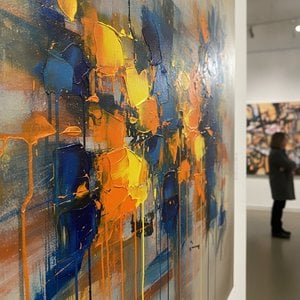
Master the high-impact world of contemporary abstraction. Discover how bold colors, textures, and modern movements like Abstract Expressionism can transform your space with premium, high-energy art curated for the design-conscious professional.

Journey through Wassily Kandinsky's 25 most iconic abstract paintings. Explore his revolutionary use of color, form & spiritual expressionism. Find museum-quality Kandinsky reproductions and elevate your home decor with WahooArt.com. Discover all masterpieces on WahooArt.com!

モンドリアン、マレーヴィチ…幾何学的抽象絵画を代表する傑作10選。各作品の背景や色彩構成、アーティストの情熱に迫ります。美術館品質の複製画はWahooArt.comで。オンラインでアートコレクションをご覧ください。

 設置イメージを確認
 送る
送る シェア
シェア
 詳細情報
詳細情報 ガイドを表示

 画像をダウンロード
 似ている作品
 X線調査
X線調査 スライドショー
 統計情報
統計情報


 続きを読む
続きを読む









 ガラスオプションは、110cm未満のサイズでのみご利用いただけます。


