
 1962
1962 65.0 x 66.0 cm
このページに掲載されている作品は著作権法によって保護されており、当社の許可なく同一の複製物を制作または販売することは法律で禁じられています。この保護は、以下のような国際条約に基づき執行されます。 ベルヌ条約 および、以下の条項に定められたものを含む各国の法律により、 米国著作権法 第17編。
この手法は、著作権で保護された作品の複製や複写を伴わないため、著作権法に完全に準拠しています。これは単なる模倣ではなく、創造的な再解釈です。元の作品からインスピレーションを受けつつも、それとは異なる、全く新しい絵画を生み出すものです。
スピーディーな制作と多彩な仕上げオプションが魅力の、ミュージアムクオリティなジークレー・キャンバスプリント。 ( 手描きの複製画を注文する デジタル画像販売へ切り替え)
作品のオリジナル比率に合わせた、当店の規定サイズからお選びください。

特定のフレームやスペースに合わせて、ご自身でサイズを指定することも可能です。選択されたサイズが元の画像の比率と一致しない場合、作品をトリミングするか、鏡面反射または単色での塗りつぶしによって画像を拡張いたします。制作を開始する前に、ご確認用のデジタルモックアップをお送りいたします。
画面上のプレビューには、実際のトリミングや拡張は反映されませんのでご注意ください。最終的な構図を正確に確認できるのは、モックアップのみとなります。
カスタムサイズも承っておりますが、元の比率を維持するためには、あらかじめ用意されたリストからサイズを選択することをお勧めいたします。
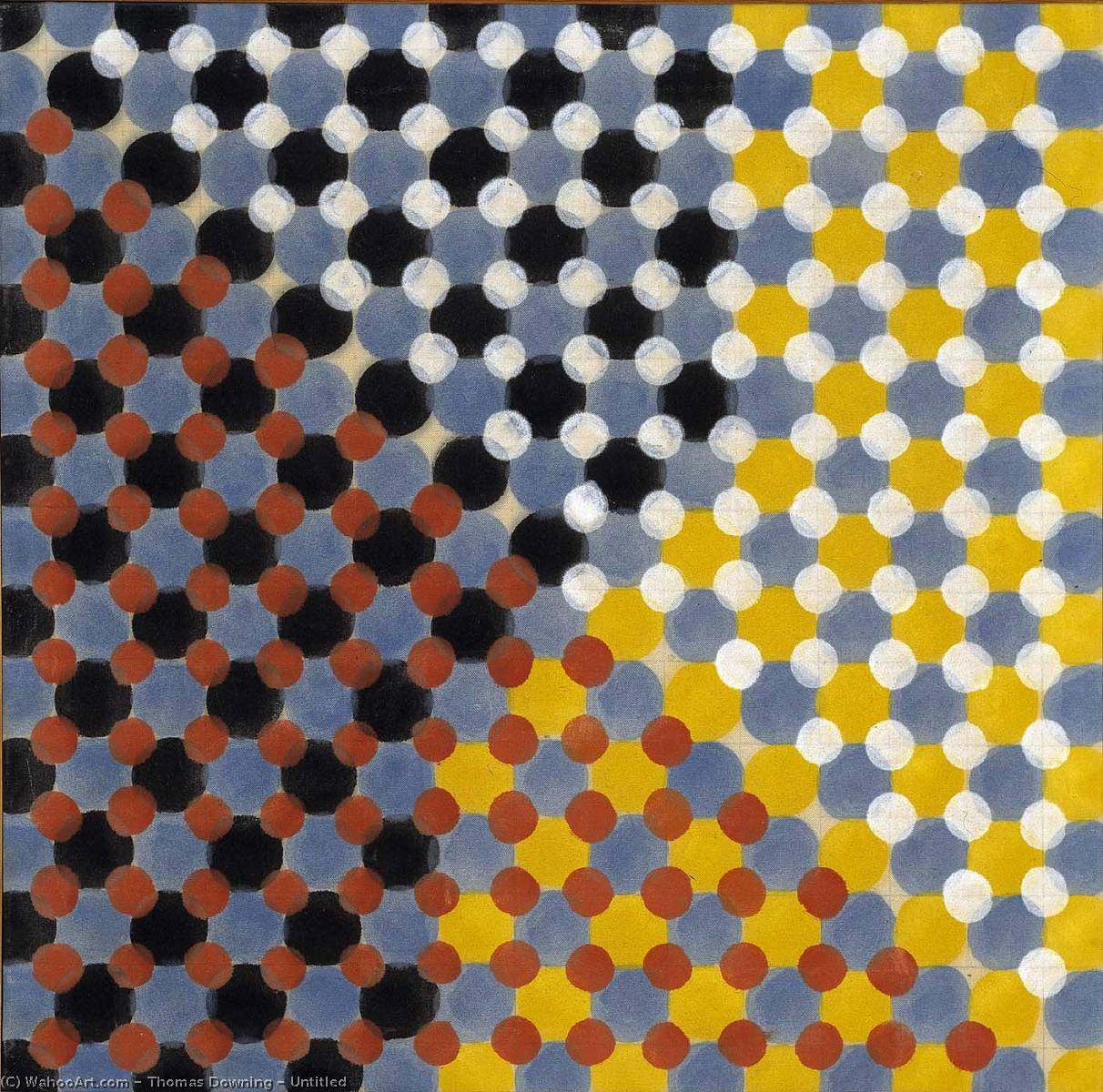
Untitled
複製画サイズ一覧
「Untitled」の彩度はVividです。彩度とは、色の鮮やかさの度合いを表します。
Thomas Downing作「Untitled」は、サイズ65 x 66 cmのSquare作品です。
Thomas Downing作「Untitled」は、Balanced Softの彩度とVividの強烈な色彩で記録されています。
「Untitled」はThomas Downingによって制作されました。このページでは、Thomas Downingのオリジナル作品についてご紹介しています。
「Untitled」は、Walnut (#844631)を主軸としたEarthyなパレットによって構成されています。
Thomas Downing作「Untitled」の制作年は1962年です。
「Untitled」はリネンキャンバスに手描きされた油彩複製画としてご購入いただけます。サイズをお選びの上、このページよりご注文いただけます。
In the vibrant tapestry of mid-century American abstraction, few threads are as precise and mesmerizing as those woven by Thomas Downing. A pivotal figure within the Washington Color Field movement, Downing possessed a singular ability to transform the canvas into a rhythmic playground of geometry and light. Born in Suffolk, Virginia, his journey toward becoming a master of the "spot painting" was marked by a rigorous pursuit of formal excellence. After earning his degree from Randolph-Macon College in 1948, he sought the creative pulse of New York, studying at the prestigious Pratt Institute. This period of intense academic honing prepared him for a transformative voyage through Europe, funded by a grant from the Virginia Museum of Fine Arts. His time at the Académie Julian in Paris allowed him to absorb the nuances of European tradition, providing a classical foundation upon which he would later build his radical, modern abstractions.
Upon returning to the United States following his service in the U.S. Army, Downing settled in Washington, D.C., a city that would become the epicenter of his artistic evolution. It was here that his path intersected with the giants of the era. Seeking to refine his vision within the burgeoning abstract landscape, he studied under Kenneth Noland at Catholic University. This mentorship was more than mere instruction; it was a profound intellectual exchange that helped shape Downing’s place within the Washington Color School. Alongside contemporaries like Howard Mehring and Sam Gilliam, Downing contributed to a movement that moved away from the gestural turbulence of Abstract Expressionism toward a cleaner, more cerebral exploration of color and form. His work became a study in balance, where the weight of a single circle could shift the entire equilibrium of a composition.
Downing’s most enduring legacy lies in his mastery of the Spot Paintings—works characterized by an exquisite arrangement of circles, arcs, and dots. Unlike the chaotic energy of his predecessors, Downing’s compositions felt orchestrated, almost mathematical, yet they pulsed with a life of their and organic vitality. He utilized color not merely as a decorative element but as a structural force. Through the use of symmetry and carefully calculated spacing, he created a sense of depth and movement that drew the viewer into a meditative state. His canvases often featured a complex interplay of primary hues—reds, yellows, and blues—set against stark whites or deep blacks, creating a visual tension that felt both modern and timeless.
The technical brilliance of his work can be seen in pieces such as Red Span and his various Untitled works from the early 1960s. In these paintings, the artist explored:
The historical significance of Thomas Downing extends far beyond his personal catalog of works. In 1964, his inclusion in Clement Greenberg’s seminal exhibition, Post-painterly Abstraction, cemented his status as a leading voice in contemporary art. As an educator at the Corcoran College of Art and Design, he also acted as a vital conduit for new ideas, influencing a subsequent generation of artists who sought to find beauty in clarity and structure. His teaching helped foster an environment where the exploration of pure form could flourish.
Though his life ended prematurely and somewhat mysteriously in Provincetown, Massachusetts, in 1985, the impact of his vision remains undiminished. Downing’s work stands as a testament to the power of restraint. He proved that within the confines of a circle or the edge of an arc, there exists an infinite universe of emotion and complexity. Today, his paintings continue to resonate as essential landmarks of American modernism, reminding us that true innovation often lies in the perfect calibration of simplicity.

 設置イメージを確認
 送る
送る シェア
シェア
 詳細情報
詳細情報 ガイドを表示

 画像をダウンロード
 似ている作品
 X線調査
X線調査 スライドショー
 統計情報
統計情報 続きを読む
続きを読む






































 ガラスオプションは、110cm未満のサイズでのみご利用いただけます。


